THE GUIDE
Garden Pests in the Pacific Northwest — Identify and Control
Pests fall into a few functional groups, and identifying which group narrows treatment dramatically. A PNW gardener's guide — including the slug problem we all share.
Pests fall into a few functional groups, and identifying which group narrows treatment dramatically. The damage style — chewing, sucking, boring — matters more than knowing the exact species. In the Pacific Northwest, slugs cause more damage than every other pest combined. Plan around them.
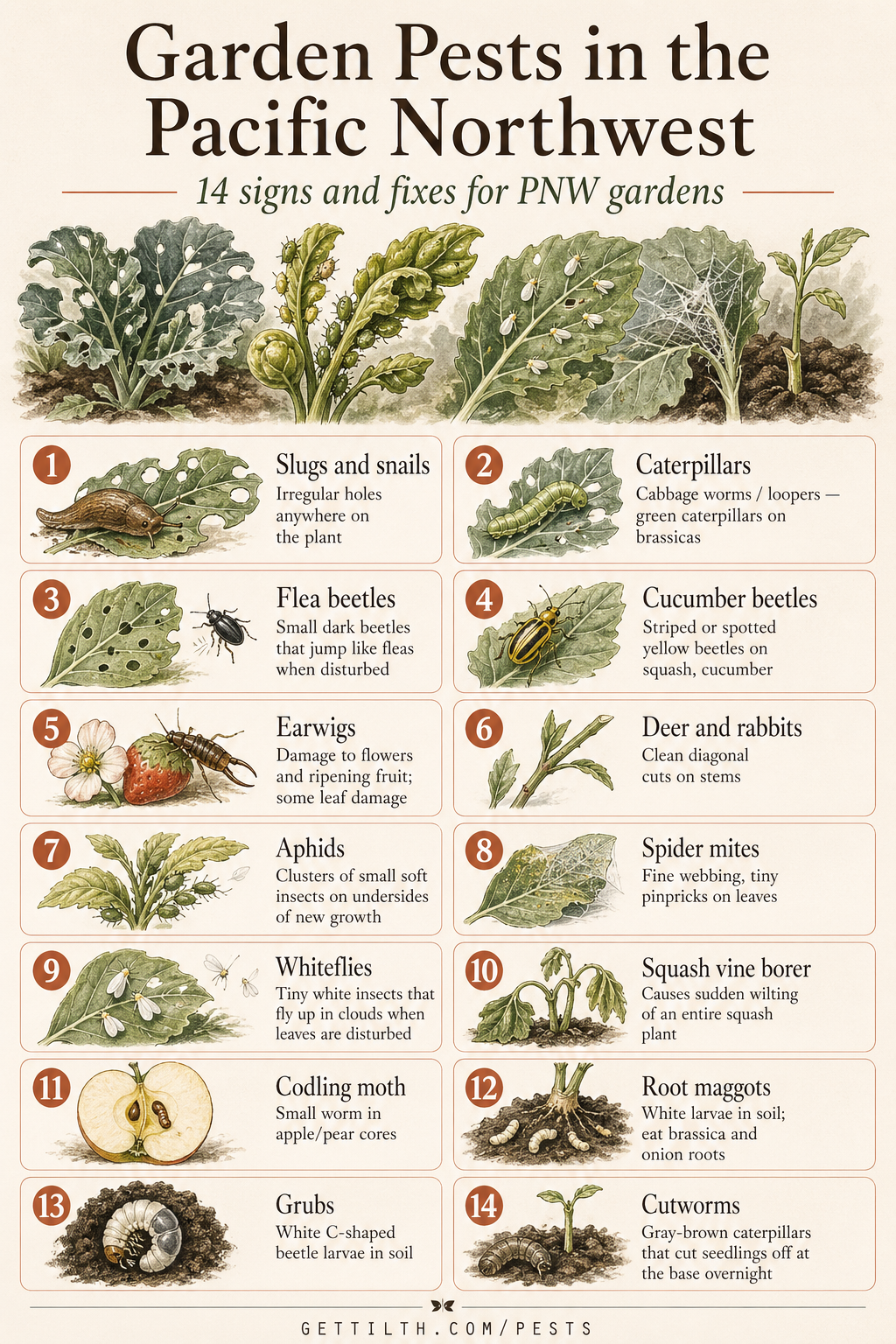
The four functional groups
Pests damage plants in distinct ways, and the type of damage tells you which group:
- Chewers → visible holes, ragged edges, missing tissue
- Suckers → curling, stunting, yellowing, sticky residue
- Borers → tunneling into stems or fruit
- Soil pests → invisible above ground; seedling collapse or unexplained stunting
Chewers
Visible damage. Most common in PNW gardens.
Slugs and snails (the dominant PNW pest)
Irregular holes anywhere on the plant. Silvery slime trails on leaves and soil. Active at night. Hostas, dahlias, lettuce, strawberries, and seedlings are favorite targets.
Control:
- Iron phosphate (Sluggo) — organic, pet-safe, very effective. Reapply after rain.
- Hand-picking at night with a flashlight — surprisingly effective
- Beer traps — shallow dish at soil level
- Copper barriers around plant bases
- Reduce hiding spots — clear mulch and debris from immediate plant base
PNW slug pressure is intense. Expect to manage them as ongoing maintenance, not a one-time fix.
Caterpillars (cabbage worms, hornworms, cutworms)
- Cabbage worms / loopers — green caterpillars on brassicas (kale, cabbage, broccoli)
- Tomato hornworms — huge green caterpillars; usually 1–2 per plant; surprising amount of damage
- Cutworms — gray-brown caterpillars at soil line; cut seedlings off at the base overnight
Control: Bt (Bacillus thuringiensis) is selective and effective on most caterpillars. Spray on leaves; caterpillars eat treated leaves and die. Harmless to non-target insects, birds, pets. Hand-pick large hornworms (use gloves).
For cutworms specifically: collar each transplant with a paper or cardboard ring extending 2 inches above and below soil line.
Flea beetles
Small dark beetles that jump like fleas when disturbed. Tiny round shotgun-pattern holes on eggplant, brassicas, radish. Worst on young plants.
Control: Row covers at planting prevent the worst damage. Diatomaceous earth around base. Healthy strong plants tolerate damage; weak seedlings get destroyed.
Cucumber beetles
Striped or spotted yellow beetles on squash, cucumber. Cause direct holes AND vector bacterial wilt — treat both problems together.
Control: Row covers at planting (remove when flowers appear for pollination). Yellow sticky traps. Hand-pick early in the season.
Earwigs
Damage to flowers and ripening fruit; some leaf damage. Active at night, hide in dark damp spots during the day.
Control: Set traps — rolled newspaper or short pieces of garden hose at soil level. Check in morning, shake earwigs into soapy water. Reduce hiding places by clearing debris.
Deer and rabbits
Clean diagonal cuts on stems (deer leave sharper edges than rabbits). Larger sections gone overnight.
Control: Fencing is the only fully reliable fix. Deer need 7–8 ft fencing; rabbits need 2 ft buried 6 inches into soil. Repellents work temporarily. Plant choices matter — daffodils, alliums, herbs are deer-resistant.
Suckers
Pierce plant tissue and drink sap. Damage is curling, stunting, yellowing, sticky residue.
Aphids
Clusters of small soft insects (green, black, white, yellow) on undersides of new growth. Sticky residue on leaves. Often on roses, brassicas, beans, lettuce.
Control:
- Strong water spray — knocks them off; often enough for light infestations
- Insecticidal soap for persistent infestations
- Neem oil for sustained control
- Encourage ladybugs — natural aphid predators
Spider mites
Fine webbing, tiny pinpricks on leaves. Common in dry, hot conditions.
Control: Increase humidity (mist plants); insecticidal soap; predatory mites for severe infestations. Healthy well-watered plants are less susceptible.
Whiteflies
Tiny white insects that fly up in clouds when leaves are disturbed. More common on greenhouse and indoor plants but appear outdoors in PNW.
Control: Yellow sticky traps; insecticidal soap; encourage parasitic wasps.
Borers
Tunnel into stems or fruit. Hard to treat once inside; rely on prevention and timing.
Squash vine borer
Causes sudden wilting of an entire squash plant. Slit the stem near the base — you’ll find a fat white grub inside.
Control: Row covers at planting (remove when flowers appear). Surgical removal of borer (slit stem, remove larva, bury stem) sometimes saves plants. Plant later varieties to dodge peak emergence.
Codling moth (apples, pears)
Small worm in apple/pear cores. Causes premature fruit drop.
Control: Pheromone traps for monitoring; beneficial nematodes in soil; harvest fallen fruit immediately to break the cycle.
Soil pests
Invisible above ground. Suspect them when seedlings collapse at the soil line or established plants stunt for no above-ground reason.
Root maggots
White larvae in soil; eat brassica and onion roots. Plants look stunted, yellowed, may collapse.
Control: Row covers at planting prevent egg-laying. Diatomaceous earth around base. Beneficial nematodes treat soil.
Grubs
White C-shaped beetle larvae in soil. Eat roots and tubers.
Control: Beneficial nematodes treat the soil; takes a season to be effective. Healthy soil with active microbiology suppresses grub populations naturally.
Cutworms
(Also listed under chewers — they’re caterpillars but operate at soil level.) Gray-brown caterpillars that cut seedlings off at the base overnight. Devastating to new transplants.
Control: Collar each transplant. Bt is less effective on cutworms because they hide during the day.
How to choose a treatment
The general principle: identify the group first, then choose the lightest treatment that works. Hand removal, water sprays, row covers, beneficial insects, and selective sprays (Bt, iron phosphate, neem) cover the vast majority of situations without nuking the rest of the garden’s ecosystem.
Avoid broad-spectrum insecticides unless absolutely necessary — they kill beneficial insects (pollinators, predators) along with the pest, and the rebound infestation is often worse because predators take longer to recover than pests.
PNW-specific notes
- Slugs are #1. Every PNW garden manages them. Iron phosphate is the standard.
- Aphids spike in spring as new growth emerges. Strong water sprays before they establish prevents major problems.
- Cucumber beetles carry bacterial wilt — treating beetles also prevents the disease.
- Powdery mildew isn’t a pest but acts like one in PNW summers — unavoidable for squash family by August.
Plant-specific notes
- Lettuce, Strawberries, Dahlia, [Hostas] — slugs are the dominant problem
- Kale, other brassicas — cabbage worms and loopers (Bt)
- Tomato — hornworms (hand-pick); aphids on new growth
- Pepper, [Eggplant] — flea beetles, especially on young plants
- Squash, Cucumber — cucumber beetles + bacterial wilt; squash vine borer
- Blueberries — Spotted Wing Drosophila in fruit; pick frequently and refrigerate
Related
- Holes in leaves — chewer damage
- Curling leaves — sucker damage (aphids)
- Wilting plants — squash vine borer, bacterial wilt
- Stunted plants — root pest damage
- The diagnosis guide — full diagnostic framework