THE GUIDE
Holes in Plant Leaves — What's Eating My Garden?
If pieces of your plant are missing, something is eating it. The shape of the damage tells you which pest. A PNW gardener's guide — including the slug problem we all share.
If pieces of your plant are missing, something is eating it. The size and shape of the damage, plus what’s left behind, narrow it down to one or two suspects faster than any other symptom. In the Pacific Northwest, slugs cause more garden damage than every other pest combined — nine times out of ten, the answer is slugs. The other 10% is worth knowing.
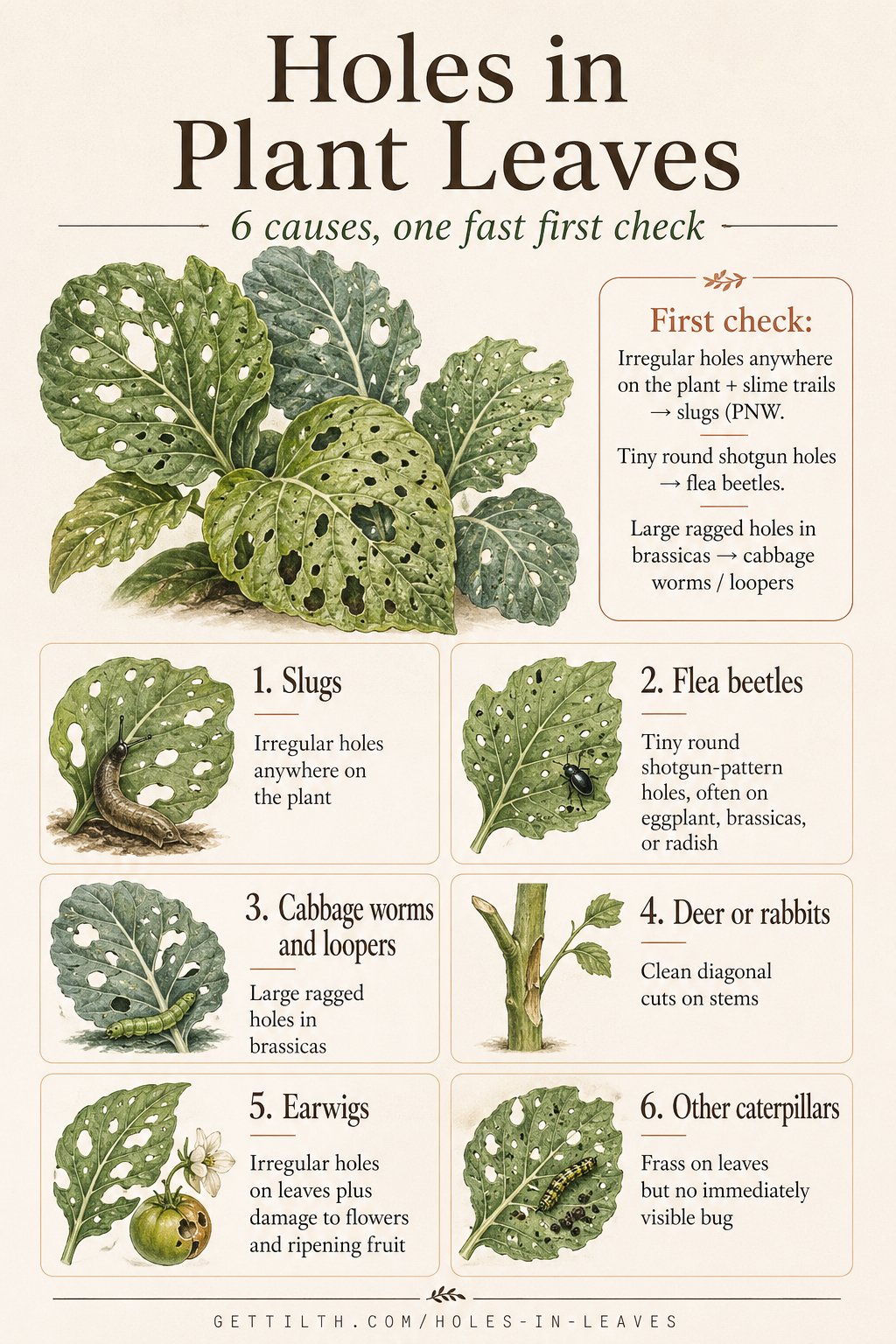
First check: look at the damage closely
The shape and pattern of holes tells you the pest:
- Irregular holes anywhere on the plant + slime trails → slugs (PNW special)
- Tiny round shotgun holes → flea beetles
- Large ragged holes in brassicas → cabbage worms / loopers
- Clean diagonal cuts on stems → deer or rabbits
- Frass (small dark droppings) on leaves → caterpillar somewhere nearby
- Ragged damage to flowers and ripening fruit → earwigs
Then look under leaves, at the soil line, and around the plant base. Most pests hide; you have to look.
Likely causes
Slugs (the dominant PNW pest)
Pattern: Irregular holes anywhere on the plant. Often silvery slime trails on leaves or nearby surfaces. Damage is worst at night and in the morning. Hostas, dahlias, lettuce, strawberries, and seedlings are favorite targets.
Confirm: Go out at dusk or early morning with a flashlight. You’ll see them. Slime trails are diagnostic; nothing else leaves them.
Fix:
- Iron phosphate (Sluggo) — organic, pet-safe, very effective. Reapply after rain.
- Hand-picking at night — surprisingly effective; takes 10 minutes a few times a week.
- Beer traps — shallow dish of beer at soil level. Slugs crawl in and drown.
- Copper barriers — strips around plant bases or beds. Slugs won’t cross copper.
- Reduce hiding spots — clear mulch and debris from immediate plant base.
PNW slug pressure is intense. Some control is required for any garden; expect to manage them as a regular task, not a one-time treatment.
Flea beetles
Pattern: Tiny round shotgun-pattern holes, often on eggplant, brassicas, or radish. The beetles themselves are small, dark, and jump like fleas when disturbed. Worst on young plants.
Confirm: Watch the plant for movement. Tap a leaf and see if tiny beetles jump. Damage pattern is unmistakable once you’ve seen it — looks like the leaf was hit with birdshot.
Fix:
- Row covers at planting — physical barrier prevents access. Most effective for young plants. Remove when flowering begins for cucurbits and tomatoes.
- Diatomaceous earth — sprinkled around base. Works when dry; reapply after rain.
- Sticky traps — yellow sticky cards trap adults.
- Healthy soil — strong plants tolerate more damage; weak seedlings get destroyed.
Cabbage worms and loopers
Pattern: Large ragged holes in brassicas (kale, cabbage, broccoli, cauliflower). Worms are pale green and well-camouflaged on leaves. Look for white butterflies (cabbage white) flying around the plants — they lay the eggs that become these caterpillars.
Confirm: Look on the underside of leaves. You’ll find the caterpillars. Frass (small green droppings) confirms presence.
Fix:
- Bt (Bacillus thuringiensis) — selective biological insecticide. Spray on leaves; caterpillars eat treated leaves and die. Harmless to non-target insects, birds, pets.
- Hand-picking — works for small infestations.
- Row covers — prevent the butterflies from laying eggs in the first place.
Deer or rabbits
Pattern: Clean diagonal cuts on stems (deer have sharp teeth; rodents leave more ragged edges). Larger sections gone overnight. Often whole tops missing.
Confirm: Look for hoofprints or droppings around the garden. Deer leave large pellet-style droppings; rabbits leave small round ones.
Fix:
- Fencing — the only fully reliable fix. Deer need 7–8 ft fencing; rabbits need 2 ft buried 6 inches into soil.
- Repellents — work temporarily; need reapplication.
- Plant choices — daffodils, alliums, herbs (rosemary, lavender) are deer-resistant.
Earwigs
Pattern: Irregular holes on leaves plus damage to flowers and ripening fruit. Active at night. Hide in dark damp spots during the day (under boards, mulch, in folded leaves).
Confirm: Set traps — rolled-up newspaper or short pieces of garden hose at soil level. Check in the morning. Earwigs will be hiding inside.
Fix: Set the traps and shake earwigs into soapy water in the morning. Reduce hiding places (clear debris). Diatomaceous earth around vulnerable plants.
Other caterpillars
Pattern: Frass on leaves but no immediately visible bug. Damage is bite-shaped (not random holes).
Confirm: Look harder. Caterpillars are usually on the underside of leaves nearby, well-camouflaged. Tomato hornworms are huge but blend with stems. Check stems and leaf undersides.
Fix: Hand-pick (use gloves for hornworms — they’re harmless but unpleasant). Bt for general caterpillar control.
Plant-specific notes
- Lettuce, Strawberries, Dahlia — slugs are the dominant problem.
- Kale, other brassicas — cabbage worms and loopers.
- Tomato — tomato hornworms (huge green caterpillars; usually 1–2 per plant).
- Pepper, [Eggplant] — flea beetles, especially on young plants.
- Squash, Cucumber — cucumber beetles cause holes AND vector bacterial wilt; treat both problems together.
When to worry vs. when not to
Don’t worry: A few small holes on a healthy mature plant. Most plants tolerate 10–20% leaf damage without measurable yield reduction.
Do worry: Damage on seedlings (slugs can destroy a seedbed in one night). Whole leaves disappearing. Damage on flower buds or developing fruit. Those need immediate intervention.
Related
- Pests — full pest taxonomy and control approaches
- Diseases — for damage that isn’t pest-caused
- The diagnosis guide — full diagnostic framework