THE GUIDE
Growing Cucumbers in the Pacific Northwest
How to grow cucumbers in the PNW: when to plant, why pickling varieties beat slicers in cool summers, and how to handle the powdery and downy mildew that show up reliably here.
Cucumbers are easier than squash but still mildew-prone. The two reliable PNW realities: pickling varieties tolerate cool conditions much better than long-fruited slicers, and one of the two main cucumber diseases (powdery or downy mildew) will almost certainly arrive by mid-summer. Plan around both.
Quick facts
- Plant: transplant late May or direct seed when soil reaches 65°F
- Sun: 6+ hours direct
- Water: 1–2 inches/week, consistent — water swings cause bitter fruit
- Soil: pH 6.0–7.0, well-amended, well-draining
- Days to harvest: 50–65 days from transplant for slicers, 50–55 for pickles
When to plant
Like squash, cucumbers want warm soil. Don’t plant before soil reaches 65°F.
Direct seed — late May to early June. Cucumbers transplant okay (better than squash) but direct seeding is reliable when timing is right.
Transplant — start indoors 3 weeks before transplant date. Don’t grow on for longer; older cucumber transplants don’t establish well.
Varieties that work
Pickling cucumbers (most reliable PNW):
- Boston Pickling — classic, prolific, 50 days
- National Pickling — reliable workhorse
- Marketmore 76 — actually a slicer but tolerates PNW conditions; close to pickling reliability
Slicing cucumbers (more challenging):
- Marketmore 76 / Marketmore 86 — workhorse PNW slicer, the standard
- Lemon cucumber — round yellow heirloom, productive in PNW
- Suyo Long — Asian heirloom, tolerates cooler conditions
- English / greenhouse types — generally need more heat than PNW provides; skip outdoors
If your slicers struggle, try pickling varieties. They’re more reliable producers in our cool summers.
Sun and soil
Cucumbers want full sun (6+ hours minimum) and rich, well-drained soil.
Amend the bed with 2–3 inches of compost worked in. Cucumbers are heavy feeders during fruit production — side-dress with compost or fish emulsion mid-season.
Trellising helps significantly. Vining types climb readily and produce straighter, cleaner fruit when trellised. Bush types stay compact but still benefit from a small support to keep fruit off the ground.
Watering
Cucumbers want consistent moisture. Inconsistent watering — alternating wet and dry — causes bitter fruit. Aim for 1–2 inches per week, deep watering, with mulch to even out swings.
Water at the soil line. Wet leaves invite both forms of mildew. Drip irrigation or soaker hoses are ideal.
Common problems
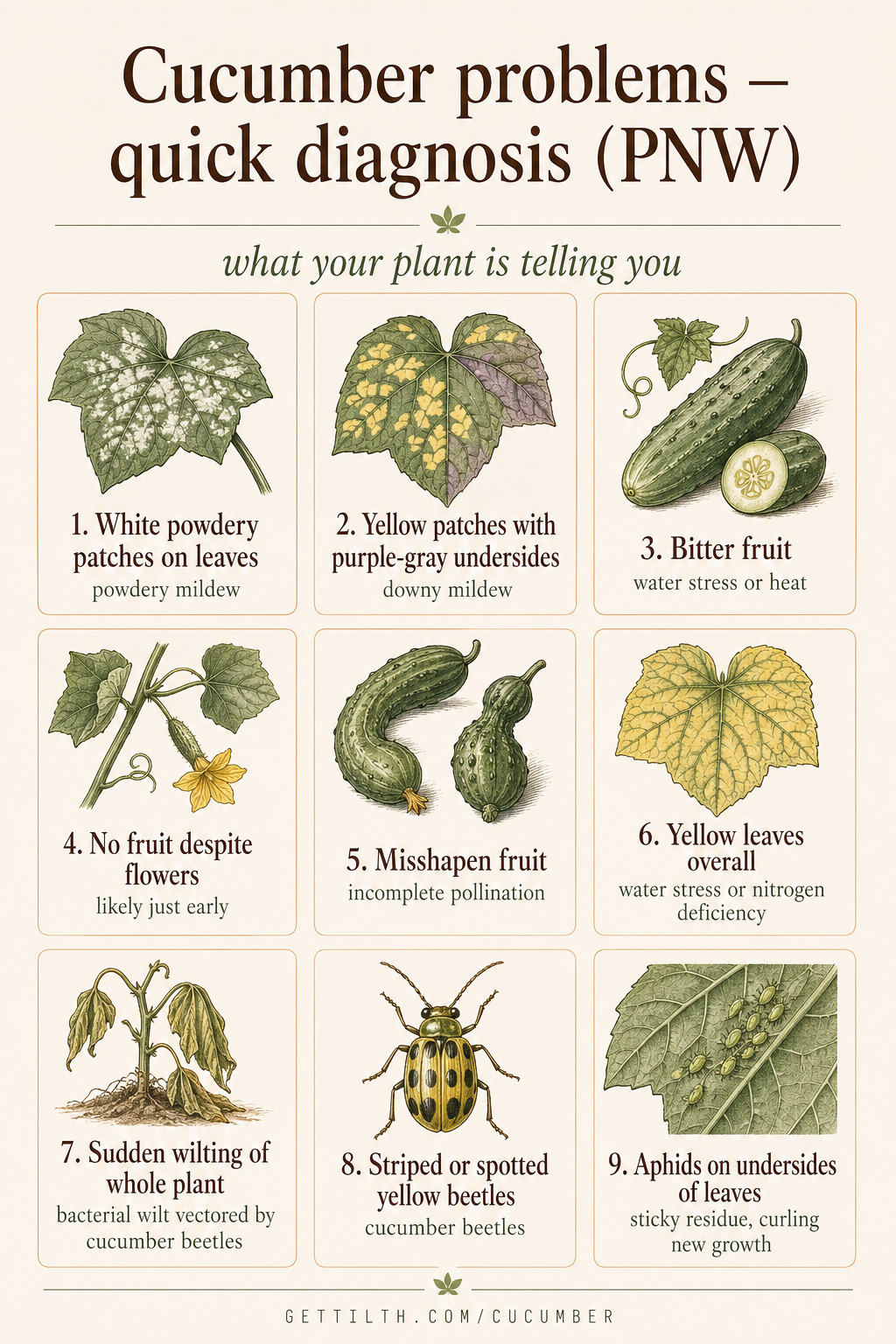
Nine most-asked-about cucumber problems in PNW gardens:
- White powdery patches on leaves — powdery mildew. Common in PNW humidity by mid-summer. Improve airflow, remove affected leaves.
- Yellow patches with purple-gray undersides — downy mildew. More aggressive than powdery; can defoliate plants quickly. Remove affected leaves and apply copper if it spreads.
- Bitter fruit — water stress (inconsistent watering) or heat. Maintain consistent moisture.
- No fruit despite flowers — likely just early. Cucumbers produce male flowers first; female flowers come a week later. If you’ve waited two weeks and still no female flowers, suspect pollination.
- Misshapen fruit — incomplete pollination. Hand-pollinate (touch a male flower’s center to a female’s center).
- Yellow leaves overall — water stress or nitrogen deficiency. Check soil moisture before fertilizing.
- Sudden wilting of whole plant — bacterial wilt vectored by cucumber beetles. Plant doesn’t recover. Remove affected plants.
- Striped or spotted yellow beetles on leaves — cucumber beetles. Treat early to prevent bacterial wilt spread; row covers at planting work best.
- Aphids on undersides of leaves — sticky residue, curling new growth. Spray off with strong water; insecticidal soap if persistent.
Harvest
Pick cucumbers young and often. Larger fruit get seedy and bitter. For most slicing varieties, harvest at 6–8 inches; for pickling varieties, 3–5 inches.
Use scissors or pruners to cut cucumbers off the vine — pulling damages stems. Check plants every 2–3 days during peak production.
Frequent harvest encourages more flower production. If you let cucumbers get oversized, the plant slows production.
Related plants
- Squash & zucchini — same family (Cucurbitaceae), similar mildew problems
- Beans — companion plant, doesn’t compete heavily for soil nutrients
- Dill, basil — herbal companions that may deter some pests
For the underlying patterns affecting cucumbers (water consistency, mildew prevention), see the diagnosis guide.