THE GUIDE
Growing Squash & Zucchini in the Pacific Northwest
How to grow squash and zucchini in the PNW: timing, varieties that work in cool summers, pest and disease management, and what to do about the powdery mildew that's almost guaranteed by August.
Summer squash thrives in PNW summers. Winter squash is harder — most varieties need 100+ days of warm weather to mature, and PNW summers don’t reliably deliver. Pick short-season winter varieties or skip them. The other reliable PNW reality: powdery mildew shows up in August, every year. Plan for it rather than fight it.
Quick facts
- Plant: direct seed late May or transplant in early June, after last frost
- Sun: 6+ hours direct
- Water: 1–1.5 inches/week, deep, water at soil level
- Soil: pH 6.0–7.0, rich compost, well-draining
- Days to harvest: 45–55 days for summer squash; 90–110 for short-season winter squash
When to plant
Squash hates cold soil. Don’t plant before the soil reaches 65°F or seeds will rot before germinating.
Direct seed — late May to early June. Squash transplants poorly because it has sensitive roots, so direct seeding is usually better than starting indoors. Plant 2–3 seeds per hill, thin to the strongest seedling.
Transplant — if you must transplant, start seeds indoors only 3 weeks before transplant date. Older transplants don’t establish well.
Varieties that work
Summer squash (zucchini, yellow squash, patty pan) — almost any variety works in PNW.
- Zucchini (any standard variety) — Black Beauty, Cocozelle, Costata Romanesco
- Yellow crookneck or straightneck — reliable
- Patty pan / scallop — productive, fun shapes
Plant 1–2 plants. They produce more than you can eat.
Winter squash — choose short-season varieties:
- Delicata — short-season (90 days), reliable in PNW, excellent flavor
- Acorn — manageable size, finishes in PNW
- Honey Bear (acorn) — bred for short seasons, earlier than standard acorn
- Sugar Pumpkin — pie pumpkins, finish in PNW
- Butternut (Waltham) — borderline; needs a hot summer
- Hubbard, Banana, Long Island Cheese — skip. Won’t finish.
Sun and soil
Squash wants full sun (6+ hours) and rich soil. They’re heavy feeders.
Amend the bed deeply with compost (3–4 inches worked into the top 8 inches of soil). Add a balanced organic fertilizer at planting. Side-dress with compost or fish emulsion when fruit set begins.
Squash plants are large — give them space. Summer squash needs 3–4 feet between plants; winter squash needs 4–6 feet plus room for vines to spread (or train them up a trellis).
Watering
Water deeply at the soil line, not on the leaves. Wet leaves invite powdery mildew, which is already a near-guarantee in PNW summers.
1–1.5 inches per week, delivered in 1–2 deep waterings. Mulch heavily to retain moisture and suppress weeds.
Common problems
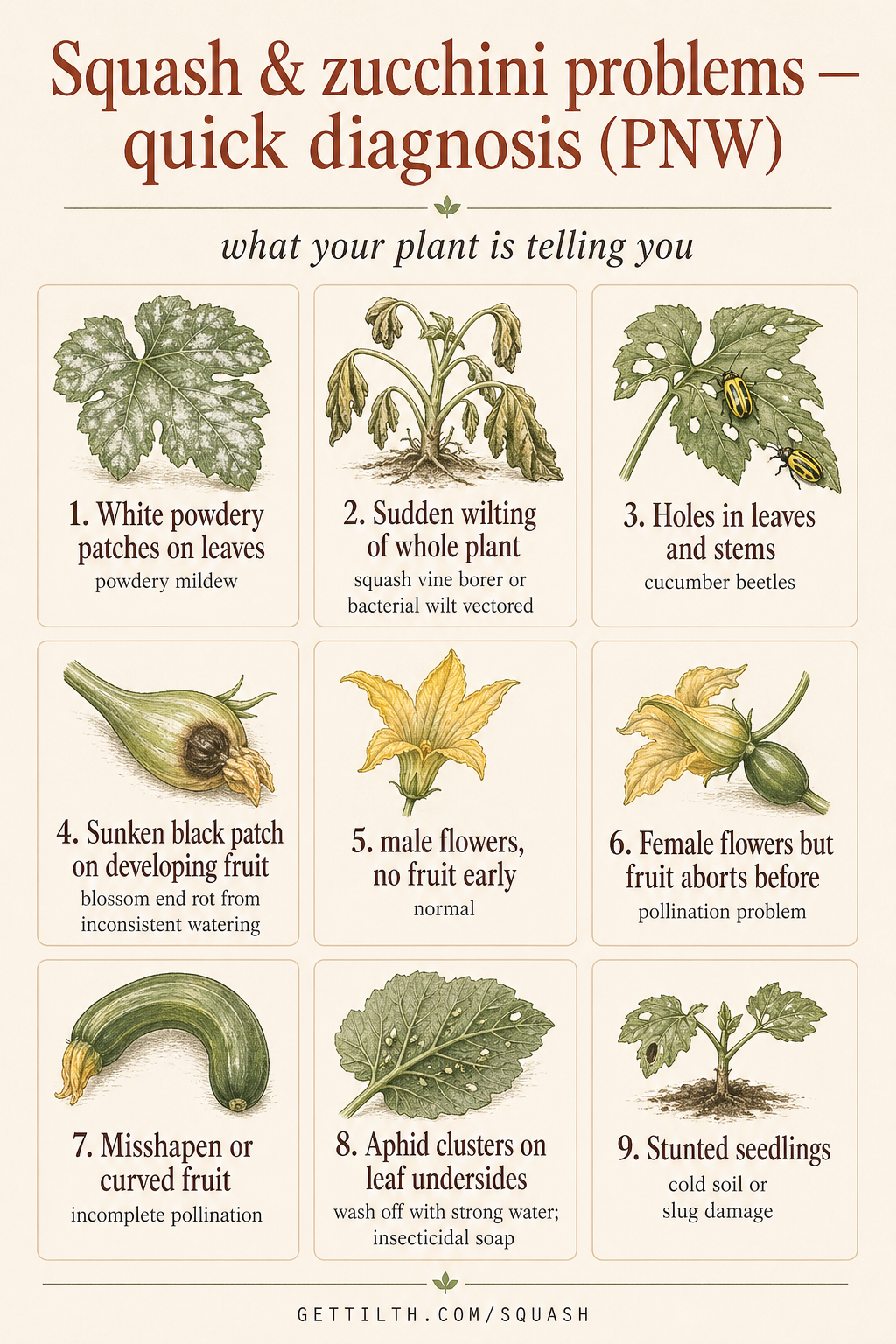
Nine most-asked-about squash problems in PNW gardens:
- White powdery patches on leaves — powdery mildew. Nearly guaranteed by August in PNW. Prune affected leaves; won’t kill plants but reduces production.
- Sudden wilting of whole plant — squash vine borer (slit the stem near the base to find the larva) or bacterial wilt vectored by cucumber beetles.
- Holes in leaves and stems — cucumber beetles. Treat early to prevent bacterial wilt spread.
- Sunken black patch on developing fruit — blossom end rot from inconsistent watering.
- Lots of male flowers, no fruit early — normal. Squash sends male flowers first; female flowers (with small fruit at the base) come a week or two later.
- Female flowers but fruit aborts before maturing — pollination problem. Hand-pollinate (touch a male flower’s center to a female’s center).
- Misshapen or curved fruit — incomplete pollination. Same fix as above.
- Aphid clusters on leaf undersides — wash off with strong water; insecticidal soap for persistent infestations.
- Stunted seedlings — cold soil (below 65°F) or slug damage. Wait for warmer soil; protect young plants from slugs at sprout time.
Harvest
Summer squash — pick young (6–8 inches for zucchini, 3–4 inches for yellow squash). Larger fruit get tough and seedy. Check plants every 2–3 days during peak season — zucchini hides under leaves and gets to bat-size overnight if missed.
Winter squash — harvest when the rind is hard enough that you can’t dent it with a fingernail and the stem starts to crack. For most PNW varieties, this is September to early October. Cure in a warm dry place for 1–2 weeks before storing for long keeping.
Related plants
- Cucumber — same family (Cucurbitaceae), similar problems
- Beans, corn — classic Three Sisters companions for winter squash
- Marigold, nasturtium — companion plants that may deter some pests
For the underlying patterns affecting squash (water management, pest pressure, disease prevention), see the diagnosis guide.