THE GUIDE
No Flowers or No Fruit — Why Won't My Plant Produce?
The most frustrating plant problem: leaves are green, growth is fine, but the whole point of growing it isn't happening. A PNW gardener's guide.
This is the most frustrating symptom because the plant looks fine — leafy, green, growing — but the whole point of growing it isn’t happening. The fix depends on whether you’re seeing flowers that drop without setting fruit, or no flowers at all. Different problems, different solutions.
In the PNW specifically, cool nights are the dominant culprit for tomatoes and other warm-fruit plants. Confirm temperatures before assuming the plant is sick.
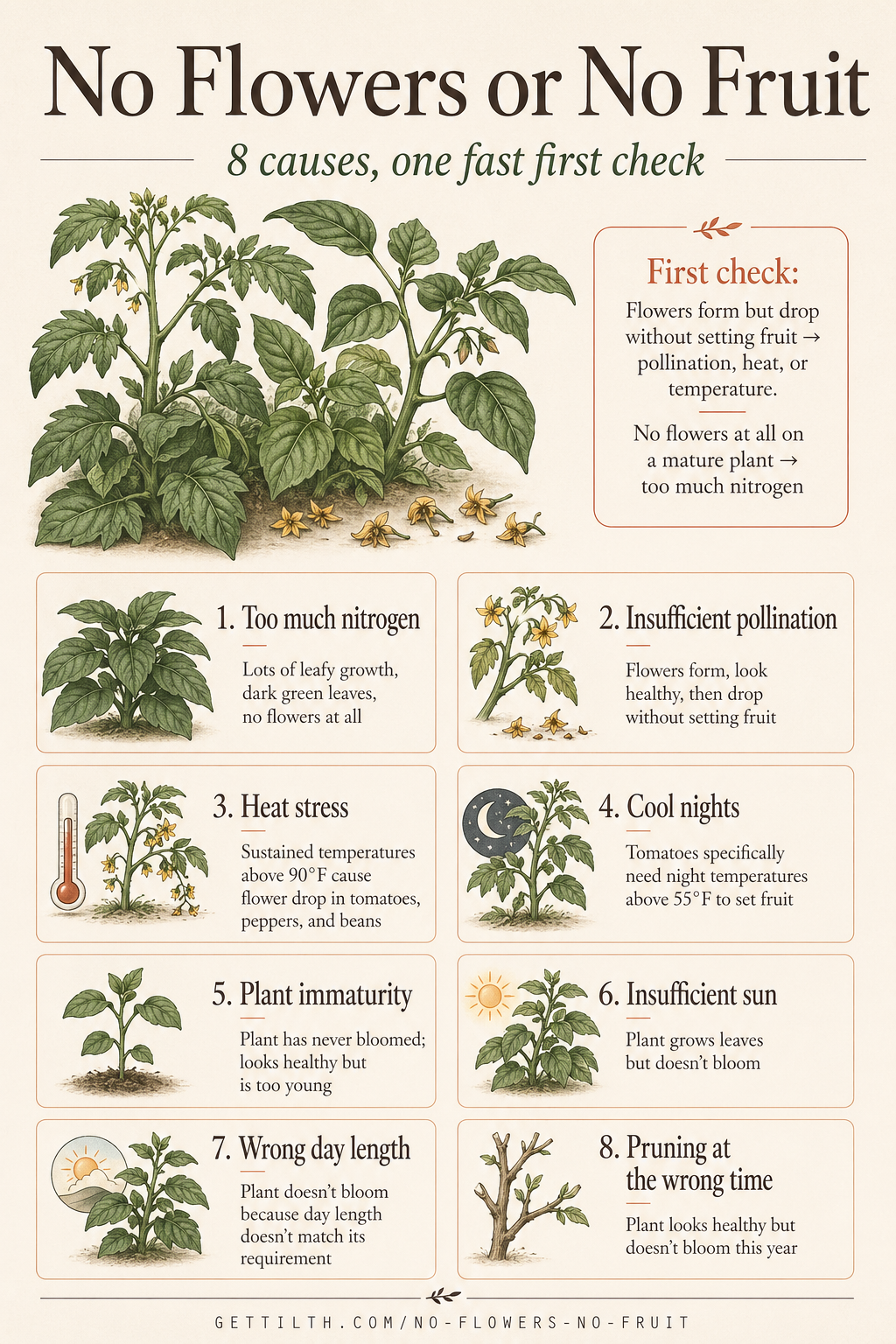
First check: flowers but no fruit, or no flowers at all?
The single most useful diagnostic distinction:
- Flowers form but drop without setting fruit → pollination, heat, or temperature problem (NOT a sick plant)
- No flowers at all on a mature plant → too much nitrogen, insufficient sun, or plant immaturity
For PNW tomatoes specifically: check whether nighttime lows have been above 55°F consistently. If they haven’t, that alone explains the absence of fruit.
Likely causes
Too much nitrogen
Pattern: Lots of leafy growth, dark green leaves, no flowers at all. Plant looks vigorous but reproduction is suppressed. Common after over-fertilizing with high-N fertilizer.
Confirm: Recent application of nitrogen-heavy fertilizer? Lots of compost or manure recently added?
Fix:
- Stop fertilizing — let the plant exhaust the nitrogen
- Don’t side-dress with nitrogen during the flowering window
- Switch to bloom fertilizer — phosphorus-heavy formulations encourage flowering
Insufficient pollination
Pattern: Flowers form, look healthy, then drop without setting fruit. Common with squash family, peppers, and tomatoes when pollinator activity is low.
Confirm: Watch the flowers. Are bees visiting them? Cool, wet, windy weather reduces bee activity.
Fix:
- Hand-pollinate — for squash, cucumber, melon: touch a male flower’s center to a female flower’s center. For tomatoes and peppers: gently shake the plant midday to release pollen.
- Plant flowers nearby — borage, calendula, alyssum attract pollinators
- Skip pesticide use during bloom
Heat stress
Pattern: Sustained temperatures above 90°F cause flower drop in tomatoes, peppers, and beans. Tropical plants can handle the heat; temperate fruiting plants can’t.
Confirm: Recent multi-day heat wave above 90°F? Plant otherwise looks healthy?
Fix: Mostly nothing — wait for cooler weather. Provide afternoon shade with shade cloth during severe heat. Plants typically resume flowering once temperatures drop.
Cool nights (the PNW special)
Pattern: Tomatoes specifically need night temperatures above 55°F to set fruit. PNW summers often hover at the bottom of this range, especially near water or in cooler microclimates. Plants flower but flowers drop.
Confirm: Check overnight lows. Below 55°F = the explanation. The plant isn’t sick.
Fix:
- Wait for warmer nights (usually mid-July onward in PNW lowlands)
- Choose early-ripening varieties — Sungold, Stupice, Early Girl set fruit at lower temperatures than larger slicers
- Plant in warmer microclimates — south-facing walls, protected courtyards
Plant immaturity
Pattern: Plant has never bloomed; looks healthy but is too young.
Confirm: How old is the plant?
- Strawberries — first-year plants produce sparingly; year 2 is full crop
- Blueberries — 3+ years to a meaningful crop
- Most fruit trees — 3–5 years to first real production
- Perennials — many bloom in year 2, not year 1
Fix: Wait. Don’t try to force flowering with fertilizer. Patience is the whole answer.
Insufficient sun
Pattern: Plant grows leaves but doesn’t bloom. Less than 6 hours of direct sun for fruiting plants.
Confirm: Count direct sun hours during peak season.
Fix: Move the plant to a sunnier spot, or accept that this isn’t the right plant for this location.
Wrong day length (photoperiod)
Pattern: Plant doesn’t bloom because day length doesn’t match its requirement. Onions are the classic example — long-day onions for northern latitudes, short-day for southern. Plant the wrong type and you get green tops but no bulb formation.
Confirm: Specific to certain crops (onions, some flowers, many tropical plants).
Fix: Choose varieties matched to your latitude. For PNW: long-day onions (Walla Walla, Copra, Ailsa Craig).
Pruning at the wrong time
Pattern: Plant looks healthy but doesn’t bloom this year. Specific to plants that bloom on old wood — mophead hydrangeas, oakleaf hydrangeas, lilacs, forsythia, azaleas, rhododendrons.
Confirm: Did you prune in fall, winter, or spring? You removed this year’s flower buds.
Fix: Don’t prune old-wood bloomers in fall, winter, or spring. Prune immediately after flowering so the plant can set new buds for next year. See Hydrangea for the full pruning rules.
Plant-specific notes
- Tomato — almost always cool nights below 55°F in PNW. Confirm temperatures first.
- Pepper — heat stress (>90°F) or cool nights, depending on the season.
- Squash, Cucumber — pollination issues common in cool wet weather. Hand-pollinate.
- Strawberries — too much nitrogen produces leaves not flowers. Year 1 plants produce sparingly.
- Blueberries — single cultivars fruit poorly; need cross-pollination. Plant 2+ varieties.
- Hydrangea — pruning at wrong time is the dominant cause. Identify your hydrangea type before pruning.
- Dahlia — too much nitrogen, too little sun, or both.
When to worry vs. when not to
Don’t worry: Tomatoes and peppers not fruiting before mid-July in PNW (cool nights). First-year strawberries producing few berries (normal). Hydrangeas not blooming the year after a hard pruning (you removed the buds).
Do worry: Mature plants in good conditions consistently failing to flower across multiple years. Entire crops failing in a season that should produce normally. Those suggest a real underlying problem.
Related
- Nutrients — over-fertilization with nitrogen
- Sunlight — insufficient sun
- Environmental stress — heat, cold nights
- The diagnosis guide — full diagnostic framework