THE GUIDE
Sunlight Problems for Plants — Too Little, Too Much
Sun mismatch is one of the easiest causes to verify and one of the slowest to recognize. A PNW gardener's guide — including the fact that PNW sun is weaker per hour than at lower latitudes.
Sun mismatch is one of the easiest causes to verify (count hours of direct sun in a spot) and one of the slowest to recognize because plants don’t crash overnight from too little light — they just refuse to thrive. A tomato in 4 hours of sun won’t die; it’ll quietly produce 30% of what it would have in 8 hours, and you’ll wonder why.
In the PNW specifically, sun is weaker per hour than at lower latitudes. 6 hours in Seattle isn’t equivalent to 6 hours in Sacramento.
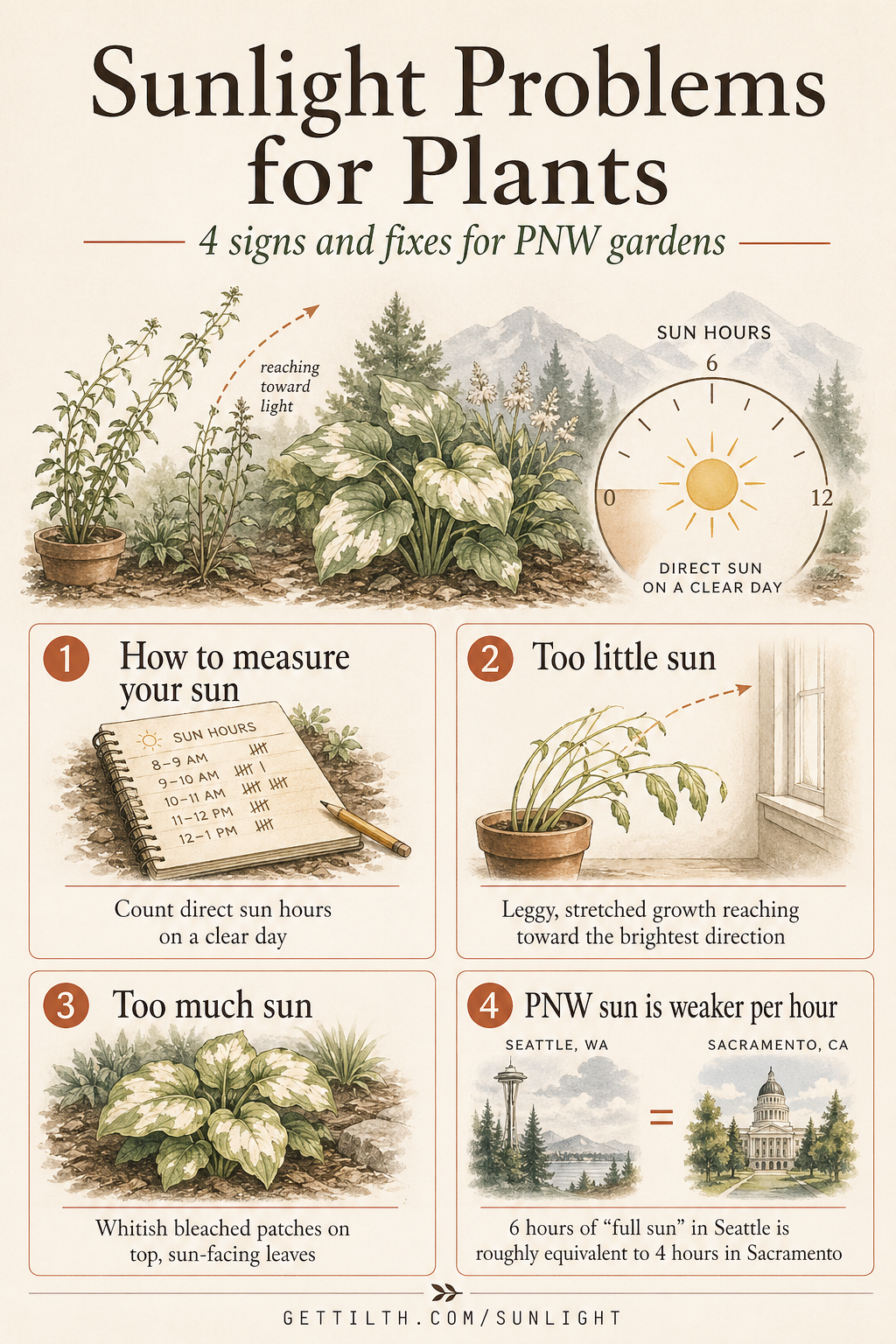
How to measure your sun
Don’t guess. Pick a sunny day in June (peak summer solstice) and watch your bed:
- 6 a.m. — note shade pattern
- 9 a.m. — note shade pattern
- 12 p.m. — note shade pattern
- 3 p.m. — note shade pattern
- 6 p.m. — note shade pattern
Add up direct sun hours. Most beds get 4 to 8. Anything over 8 is “full sun”; 6–8 is “mostly sunny”; 4–6 is “partial shade”; under 4 is “shade.”
Repeat in mid-March or early September to understand shoulder-season conditions, when sun angle is much lower and many beds get less direct light than you’d expect.
Too little sun (most common in PNW)
Pattern:
- Leggy, stretched growth reaching toward the brightest direction
- Pale, thin leaves
- Few or no flowers / fruit on plants that should produce
- Slow overall growth despite adequate water and nutrients
PNW gardens often have less sun than gardeners think because of:
- Tall trees on neighboring properties
- North-facing slopes
- Tall houses or fences blocking morning or evening sun
- Cloud cover (PNW gets 35% sun in winter, 65% in summer — significantly less than most US regions)
Fix:
- Track actual sun hours (per the measurement above)
- For chronic shade, switch crops. Don’t fight the conditions:
- 4 hours sun → leafy greens (lettuce, kale, chard, spinach), herbs, root crops with patience
- 6 hours sun → most vegetables work but heat-lovers struggle
- 8 hours sun → tomatoes, peppers, squash, melons all viable
- Prune surrounding shade if possible — overhanging branches, etc.
- Reflect more light — light-colored fences or walls bounce more usable light into shaded beds
Too much sun (especially sudden)
Pattern:
- Whitish bleached patches on top, sun-facing leaves
- Crispy edges that appear within hours of a hot afternoon
- Common after moving a plant from indoors or shade to direct sun without hardening off
PNW too-much-sun is rare during normal weather but happens during heat waves above 90°F or when transplants are moved without acclimation.
Fix:
- Harden off transplants over a week before exposing to full sun:
- Day 1: 1 hour direct sun, then move back to shade
- Day 2: 2 hours
- Day 3: 3 hours
- And so on, up to full exposure
- Add shade cloth during heat waves above 90°F — temporary, just for the worst stretches
- Mulch heavily — keeps roots cool, retains moisture
- Move container plants to part-shade during heat waves
PNW sun is weaker per hour
A factor PNW gardeners often miss: at our latitude (47°N for Seattle), the sun is at a lower angle and travels through more atmosphere than at lower latitudes. Plus our cloud cover is significant even in summer.
Practical implications:
- 6 hours of “full sun” in Seattle is roughly equivalent to 4 hours in Sacramento or 3 hours in Phoenix
- A bed that’s “full sun” by PNW standards may still be marginal for heat-loving plants
- Choose varieties bred for cool short seasons rather than the highest-yielding warm-climate options
For tomatoes, this means choosing 50–75 day varieties (Sungold, Stupice, Cherokee Purple) over 80+ day types. For peppers, this means small-fruited varieties (jalapeño, shishito) over bell types. For melons and watermelons, this means specialized PNW varieties or skipping them entirely.
Plant-specific notes
- Tomato, Pepper — need 8+ hours direct in PNW for reliable production. Less than 6 hours and you’re growing leaves, not fruit.
- Lettuce, Kale — PNW thrives at this. 4–6 hours is fine; more is okay but afternoon shade in summer extends the harvest.
- Blueberries — 6+ hours for best production. Tolerate part shade but produce significantly less.
- Rhododendron — 4–6 hours filtered light is ideal. Full PNW afternoon sun causes leaf scorch and lace bug damage.
- Hydrangea — 3–6 hours, with afternoon shade preferred. Too much sun causes wilt and brown edges.
- Dahlia — 6+ hours for blooms. Less and you get leaves with few flowers.
Related
- Stunted plants — insufficient sun is a common cause
- No flowers / no fruit — same
- Brown leaves — sun scorch / sunscald
- The diagnosis guide — full diagnostic framework