THE GUIDE
Growing Lettuce in the Pacific Northwest
How to grow lettuce in the PNW: when to plant for spring and fall, why summer is tough, the slug problem every PNW gardener has, and varieties that handle our long cool seasons.
PNW is excellent lettuce country. Long cool springs and falls give us two distinct lettuce seasons; mild winters mean overwintered crops are realistic in milder microclimates. The hard part is summer — once temperatures push past 75°F consistently, lettuce bolts (sends up a flower stalk) and turns bitter. Plant for two seasons, not one, and skip July–August unless you’re growing in shade.
Quick facts
- Plant: transplant March–April for spring; direct seed August–September for fall
- Sun: 4–6 hours direct, partial shade welcome in summer
- Water: 1–1.5 inches/week, consistent
- Soil: pH 6.0–7.0, well-amended
- Days to harvest: 30–60 days from transplant, depending on variety and harvest style
When to plant
Plan for two crops a year, with a gap during the hot months.
Spring crop:
- Start indoors: February to early March
- Transplant: March to April, when nights are reliably above freezing
- Harvest: April through June
Fall crop:
- Direct seed or transplant: mid-August through September
- Harvest: September through November (and beyond with row cover)
Winter crop (advanced):
- Cold-hardy varieties (Winter Marvel, Rouge d’Hiver) seeded September can overwinter under row cover and produce through winter in mild PNW microclimates.
Avoid planting June through July. Even bolt-resistant varieties bolt under sustained heat.
Varieties that work
Heat-tolerant (worth a try in summer):
- Sierra — slow to bolt
- Jericho — Israeli romaine, heat-tolerant
- New Red Fire — loose-leaf, slow to bolt
Spring/fall reliable:
- Buttercrunch — small butterhead, classic PNW lettuce
- Black-Seeded Simpson — quick loose-leaf, the workhorse
- Romaine (Parris Island, Cimarron) — uprights, productive
- Salanova types — mini-head, multiple harvests per plant
Cold-hardy (overwintering):
- Winter Marvel — overwinters under cloth
- Rouge d’Hiver — French heirloom, hardy
Sun and soil
Lettuce wants 4–6 hours of direct sun for spring/fall crops. In summer, it benefits from afternoon shade. Plant under taller crops (tomatoes, peppers) or use shade cloth to extend the harvest window into June.
Soil should be rich and well-amended. Lettuce is a light feeder but appreciates compost-rich soil for steady growth. Add a balanced organic fertilizer at planting; no need to side-dress for short-cycle crops.
pH 6.0–7.0 is ideal. PNW soil is generally close to this without amendment.
Watering
Consistent moisture is critical. Lettuce wilts visibly when thirsty, and stress accelerates bolting. Water at the soil line; wet leaves can invite downy mildew.
Mulch with straw or fine compost to retain moisture and suppress weeds.
Common problems
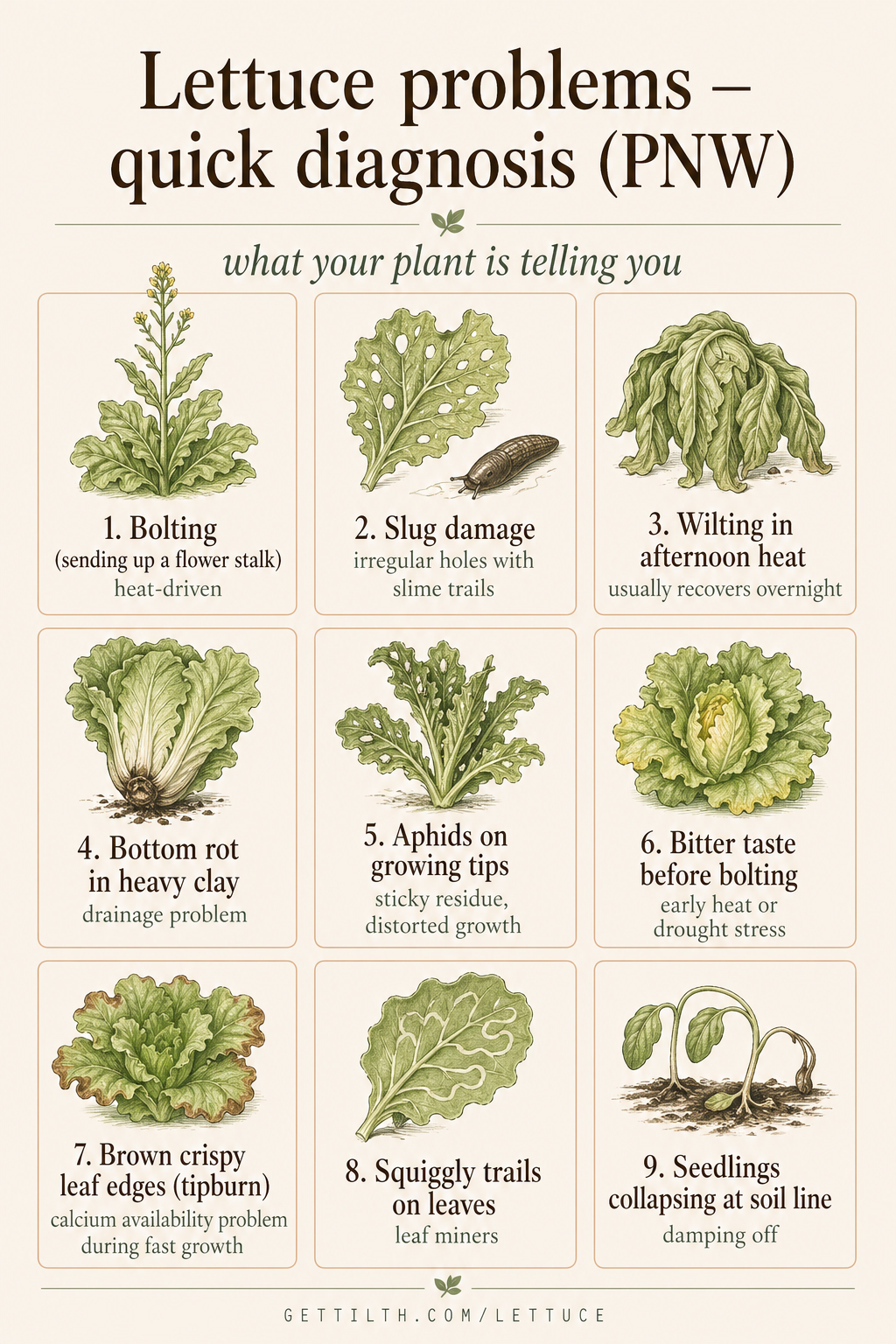
Nine most-asked-about lettuce problems in PNW gardens:
- Bolting (sending up a flower stalk, going bitter) — heat-driven. Plant earlier in spring and later in fall to dodge the heat window. Choose heat-tolerant varieties for shoulder seasons.
- Slug damage — irregular holes with slime trails. The dominant PNW lettuce pest. Iron phosphate at planting; hand-pick at night.
- Wilting in afternoon heat — usually recovers overnight. Normal for lettuce; not a sign of disease.
- Bottom rot in heavy clay — drainage problem. Raise the bed or amend with compost.
- Aphids on growing tips — sticky residue, distorted growth. Wash off with water; insecticidal soap if persistent.
- Bitter taste before bolting — early heat or drought stress. Maintain consistent moisture; provide afternoon shade in late spring.
- Brown crispy leaf edges (tipburn) — calcium availability problem during fast growth. Stabilize watering; the leaves themselves are still edible if trimmed.
- Squiggly trails on leaves — leaf miners. Remove affected leaves; they’re cosmetic on outer leaves but ruin lettuce for salad.
- Seedlings collapsing at soil line — damping off. Common in cool wet PNW spring. Use sterile seed-starting mix; don’t overwater.
Harvest
Two harvest styles:
Cut-and-come-again — for loose-leaf varieties. Cut outer leaves once they’re 4+ inches; the plant continues producing for weeks.
Whole-head harvest — for butterhead and romaine. Cut the entire plant at the base when the head is full. The plant won’t regrow.
Harvest in the morning when leaves are turgid. Wash and store in a damp cloth in the fridge — fresh PNW lettuce keeps a week.
When a plant starts to bolt (sends up a center stalk), pull it. The leaves turn bitter quickly once bolting begins.
Related plants
- Kale — similar cool-season profile, much more heat-tolerant
- Spinach, arugula, chard — all share lettuce’s spring/fall window
- Carrots, radishes — quick companions that interplant well
For underlying patterns affecting lettuce (heat stress, slug pressure, watering), see the diagnosis guide.