THE GUIDE
Plant Diseases in the Pacific Northwest — Identify and Manage
Plant diseases come from three sources: fungi (most common), bacteria, and viruses. Each looks different and responds to different actions. A PNW gardener's guide.
Plant diseases come from three sources: fungi (by far the most common — roughly 80% of plant disease), bacteria, and viruses. Each looks different, responds to different actions, and rewards prevention over treatment in every case.
In the PNW specifically, powdery mildew is the dominant fungal disease (essentially guaranteed on squash family by August), and late blight is the most dangerous (can wipe out tomato and potato crops in days during cool wet summers).
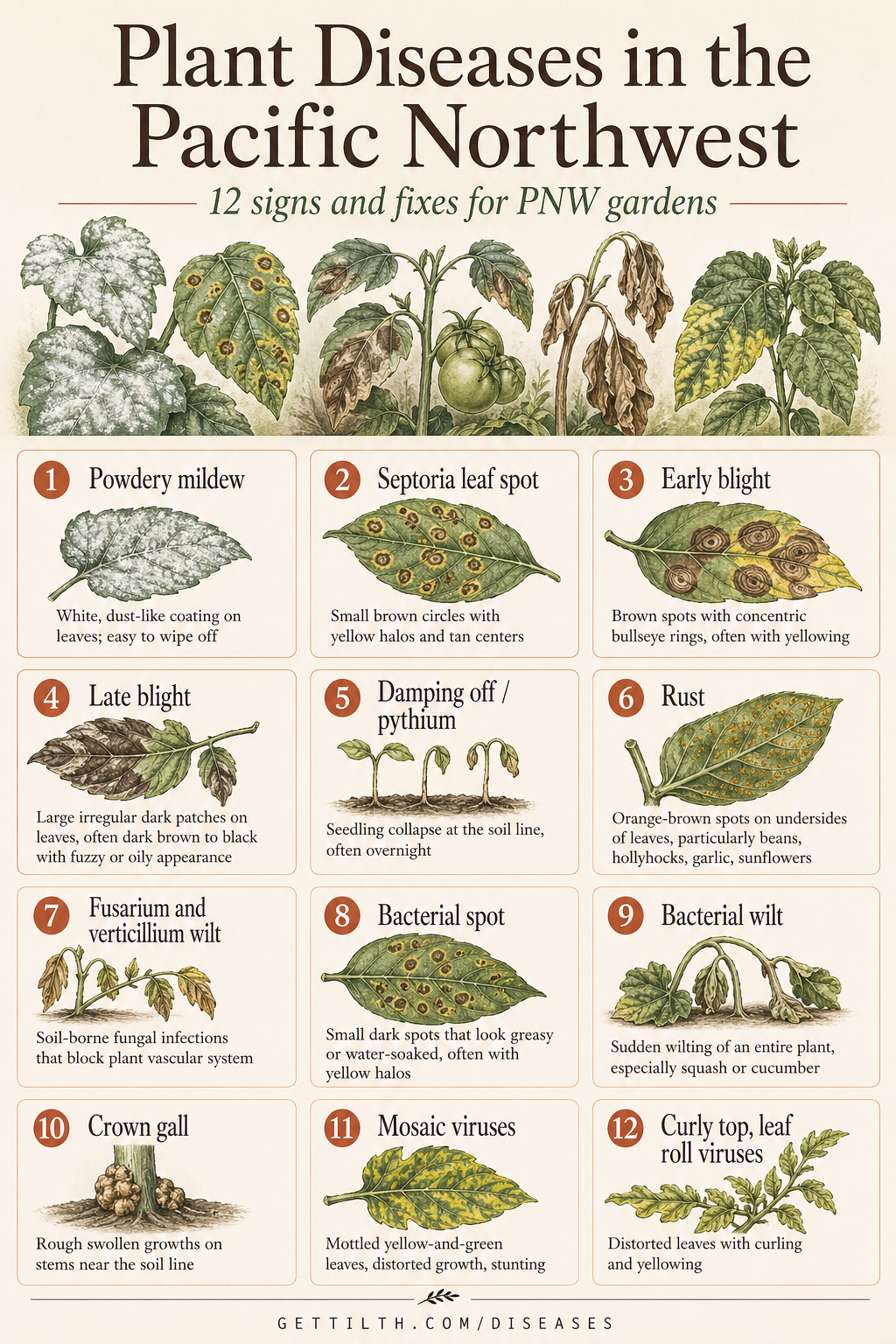
How to recognize the type
Pattern matters more than individual lesions:
- Spreads fast in wet conditions → fungal
- Greasy or water-soaked spots → bacterial
- Distorted leaves with mottled coloring → viral
Fungal diseases (most common)
Powdery mildew
White, dust-like coating on leaves; easy to wipe off. Spreads in humid conditions. Common on squash, zucchini, cucumber, beans, zinnias.
Manage:
- Improve air circulation (prune crowded interior leaves)
- Water at soil level only (never overhead)
- Remove affected leaves before it spreads widely
- Milk spray (1:9 milk to water, weekly preventive — surprisingly effective)
- Sulfur or potassium bicarbonate sprays for advanced cases
- Accept some loss — PNW powdery mildew is essentially inevitable on squash
Septoria leaf spot
Small brown circles with yellow halos and tan centers. Spreads from lowest tomato leaves upward. Nearly universal on PNW tomatoes.
Manage: Remove affected leaves immediately (don’t compost — bag and trash). Mulch heavily to prevent soil splash. Water at soil level only. Improve air circulation. Copper sprays slow spread but won’t cure existing damage.
Early blight
Brown spots with concentric bullseye rings, often with yellowing. Tomato and potato are typical hosts. Spreads from bottom of plant upward.
Manage: Same as septoria. Crop rotation matters — don’t plant tomatoes or potatoes in the same bed for 3+ years if you’ve had blight.
Late blight
Large irregular dark patches on leaves, often dark brown to black with fuzzy or oily appearance. Spreads catastrophically — can defoliate plants in days. The most serious garden disease.
Manage:
- Remove and destroy entire affected plants — late blight spreads on the wind and can wipe out a neighborhood’s tomato crop
- Don’t compost infected material — bag and trash
- Don’t replant tomatoes or potatoes in the same bed for 3+ years
- Resistant varieties — Mountain Magic, Defiant, Plum Regal for tomatoes
PNW late blight is most common in cool wet summers. Some years it doesn’t show up; others it’s everywhere.
Damping off / pythium
Seedling collapse at the soil line, often overnight. Common in cool wet conditions. PNW spring is prime season.
Manage: Improve drainage and air circulation around seedlings. Use sterile seed-starting mix. Don’t overwater. Once damping off has started in a flat, affected seedlings won’t recover.
Rust
Orange-brown spots on undersides of leaves, particularly beans, hollyhocks, garlic, sunflowers.
Manage: Remove affected leaves. Improve air circulation. Sulfur sprays for severe cases. Crop rotation. Resistant varieties when available.
Fusarium and verticillium wilt
Soil-borne fungal infections that block plant vascular system. Wilting that progresses one branch or one side at a time, doesn’t recover after watering.
Manage: Remove and destroy infected plants. Don’t replant the same family in that bed for 4+ years. Choose resistant varieties (labeled VFN or VFFNT for tomatoes and cucumbers).
Bacterial diseases
Bacterial spot
Small dark spots that look greasy or water-soaked, often with yellow halos. Spreads fast in warm wet weather. Common on peppers, tomatoes.
Manage:
- Remove affected leaves
- Don’t water from above
- Copper sprays can slow spread
- Crop rotation (bacterial spot persists in soil)
- Sanitize tools between plants
Bacterial wilt
Sudden wilting of an entire plant, especially squash or cucumber. Vectored by cucumber beetles — manage the beetles to manage the disease.
Manage: Remove and destroy infected plants. Treat for cucumber beetles to prevent spread. Resistant varieties when available.
Crown gall
Rough swollen growths on stems near the soil line. Common on roses, fruit trees, raspberries.
Manage: Remove and destroy affected plants. Soil remains infected for years; don’t replant susceptible plants.
Viral diseases
Mosaic viruses
Mottled yellow-and-green leaves, distorted growth, stunting. Various crops affected (tomatoes, cucumbers, beans, squash).
Manage: Remove infected plants. Don’t compost. Control aphids and other vectors. Sanitize tools (1:10 bleach solution between plants if you’ve worked with infected material). No cure for viruses.
Curly top, leaf roll viruses
Distorted leaves with curling and yellowing. Often vectored by leafhoppers.
Manage: Same as mosaic. Remove infected plants; control vectors.
How to manage diseases
Prevention beats treatment
For all three categories, prevention is far more effective than treatment. Established disease usually can’t be cured — only slowed or contained.
General preventive measures:
- Improve air circulation — prune crowded plants; space appropriately at planting
- Water at soil level only — never overhead. Wet leaves invite fungal disease.
- Mulch heavily — prevents soil splash, the main vector for many soil-borne diseases
- Crop rotation — don’t plant the same family in the same bed for 3–4 years if you’ve had disease there
- Sanitation — remove diseased material immediately; don’t compost; sanitize tools
- Resistant varieties — choose disease-resistant cultivars when available
Treatment options
For fungal diseases:
- Cultural changes (air, watering) — first line
- Copper sprays — slow spread of many fungal diseases
- Sulfur sprays — effective for powdery mildew and rust
- Milk spray — surprisingly effective for powdery mildew
For bacterial diseases:
- Cultural changes only — bacterial diseases respond poorly to treatment
- Copper can slow spread
For viral diseases:
- No treatment exists. Remove infected plants to prevent spread.
PNW-specific notes
- Powdery mildew on squash: essentially guaranteed by mid-August. Plan for it.
- Septoria leaf spot on tomatoes: nearly universal. Mulch + soil-level watering minimize damage.
- Late blight on tomatoes/potatoes: variable by year. Cool wet summers = bad year. Watch the weather.
- Damping off on seedlings: common in cool wet PNW spring. Sterile mix and good drainage prevent.
- Crown gall on roses, raspberries: appears occasionally; remove and don’t replant.
Plant-specific notes
- Tomato — septoria, early blight, late blight, fusarium wilt all possible. Mulch and soil-level water prevent most issues.
- Squash, Cucumber — powdery mildew is inevitable; bacterial wilt vectored by cucumber beetles.
- Pepper — bacterial spot in wet years.
- Strawberries — gray mold (botrytis) on fruit; leaf spot in wet springs.
- Blueberries — generally disease-free in PNW; bigger issues are pH and birds.
- Rhododendron — root rot from waterlogged soil is the dominant disease.
Related
- Spots — visible disease patterns
- Wilting plants — vascular wilt diseases
- Yellow leaves — disease-related yellowing
- Pests — pests that vector disease
- The diagnosis guide — full diagnostic framework