THE GUIDE
Growing Peppers in the Pacific Northwest
How to grow peppers in the PNW: when to plant, why bell peppers struggle here, what varieties actually produce, and how to add the heat peppers need to thrive.
Peppers are the most stubbornly heat-loving plant a PNW gardener tries to grow. They evolved in tropical mountains and want soil temperatures, day temperatures, and night temperatures that the Pacific Northwest only intermittently delivers. Bell peppers struggle the most. Small-fruited types — jalapeños, shishitos, hot peppers — are dramatically more reliable. The fix isn’t trying harder; it’s choosing varieties that actually want what your garden offers.
Quick facts
- Plant: transplant after May 15–20, when soil reaches 60°F. Black plastic mulch helps significantly.
- Sun: 8+ hours direct, every available beam
- Water: 1 inch/week — less than tomatoes, especially during fruit set
- Soil: pH 6.5–7.0, well-draining
- Days to harvest: 60–80 from transplant for green peppers; longer for fully ripe (red, yellow, purple) fruit
When to plant
Peppers need warm soil more than warm air, and PNW soil is slow to warm. The standard guidance: wait until soil is reliably above 60°F, which usually means mid-to-late May.
Start indoors — late February to early March. Peppers need 8–10 weeks indoors to reach transplant size. They’re slower than tomatoes; start them earlier.
Transplant outdoors — May 15–20 in most of western Washington. If you have a soil thermometer, check it: 60°F is the floor. If your soil hasn’t hit it, wait. A pepper transplanted into 55°F soil will sit and sulk for two weeks. The same plant put in 60°F soil will grow.
Adding heat
Peppers benefit from any trick that adds soil and air warmth:
- Black plastic mulch — laid down 2 weeks before transplant to pre-warm soil, then planted through. Adds 5–10°F of soil temperature throughout the season.
- Walls of Water or season extenders — protect young plants from cool nights in May–June.
- Row cover — use lightweight cover early in the season; remove when flowers appear (peppers self-pollinate but appreciate insect activity).
- South-facing position — against a south wall or fence, where reflected heat from siding helps.
- Dark-colored containers — peppers thrive in 5+ gallon black pots, which absorb sun and warm the root zone.
Without at least one of these, PNW peppers tend to grow slowly and produce sparingly.
Varieties that work in the PNW
Small-fruited types beat bell peppers handily here. Go with:
Hot peppers (most reliable):
- Jalapeño — staple, tolerates cooler conditions, prolific
- Serrano — hotter than jalapeño, similarly reliable
- Padrón — Spanish frying pepper, harvest small and green
- Shishito — Japanese frying pepper, productive and forgiving
Sweet peppers (more challenging):
- Lipstick — small red sweet pepper, ripens in PNW seasons
- Carmen — Italian-type sweet, faster than bell peppers
- King of the North — bell-type bred for cool short seasons; the most realistic bell option in PNW
- California Wonder and most standard bell peppers — skip. Won’t ripen reliably.
If you want to grow bells, plan to harvest most of them green. Waiting for them to turn red can mean losing the crop to fall weather.
Sun and soil
Peppers want every available hour of direct sun. 8+ hours is the floor; 10–12 hours is better. Less than 6 hours and you’ll get a small plant with few peppers.
Soil should be rich but not heavily fertilized — too much nitrogen produces leafy plants with sparse fruit (the same trap as tomatoes). Amend with compost before planting; add a balanced organic fertilizer at transplant. Don’t side-dress with high-nitrogen fertilizer.
pH 6.5–7.0 is ideal. Slightly more alkaline than tomatoes prefer.
Watering
Peppers want less water than tomatoes, particularly during fruit set. Aim for 1 inch per week, deep watering. Over-watering during flowering causes flower drop.
Mulch (straw, wood chips, or black plastic for thermal benefit) helps regulate soil moisture and keeps roots warm.
Common problems
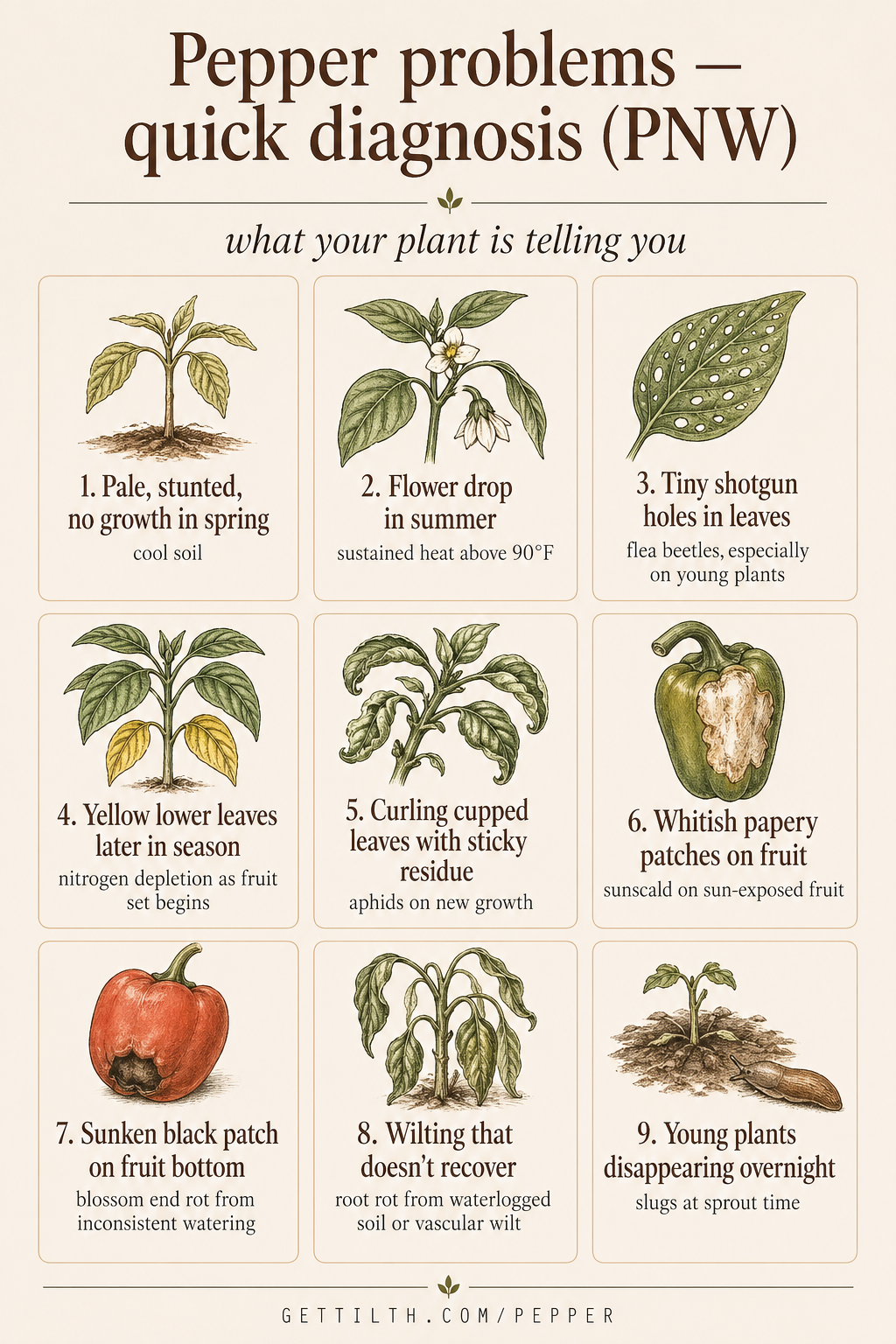
Nine most-asked-about pepper problems in PNW gardens — most about temperature, not pests or disease:
- Pale, stunted, no growth in spring — cool soil. Peppers won’t grow until soil warms past 60°F. Patience or season extension.
- Flower drop in summer — sustained heat above 90°F. Less common in PNW than in hotter regions, but happens during heat waves.
- Tiny shotgun holes in leaves — flea beetles, especially on young plants. Row covers prevent the worst.
- Yellow lower leaves later in season — nitrogen depletion as fruit set begins. Side-dress lightly with compost or fish emulsion.
- Curling cupped leaves with sticky residue — aphids on new growth. Spray off with strong water; insecticidal soap if persistent.
- Whitish papery patches on fruit — sunscald on sun-exposed fruit. Don’t strip leaves shading the fruit.
- Sunken black patch on fruit bottom — blossom end rot from inconsistent watering. Stabilize watering; calcium availability problem, not deficiency.
- Wilting that doesn’t recover — root rot from waterlogged soil or vascular wilt disease. Improve drainage; remove infected plants.
- Young plants disappearing overnight — slugs at sprout time. Iron phosphate or hand-pick at night. PNW slug pressure on tender pepper transplants is real.
Harvest
Most peppers can be harvested at any stage from immature green onward. Bell peppers and most sweet types are typically picked green for storage, then ripen further on the counter. Letting peppers ripen on the plant (red, yellow, purple) increases sweetness but takes weeks longer.
Hot peppers are usually harvested when fully colored — the color change indicates the capsaicin levels are mature.
Use sharp scissors or pruners to cut peppers off the plant. Pulling can damage stems.
Related plants
- Tomato — same family (Solanaceae), similar growing approach
- Eggplant — same family, even more cold-sensitive than peppers
- Basil — companion plant, similar conditions
For underlying patterns affecting peppers (cool-soil stalls, flower drop, pest pressure), see the diagnosis guide.