THE GUIDE
Curling Leaves on Plants — What's Happening?
Leaf curl tells you what direction the plant is trying to defend against. The pattern of curl narrows the cause down quickly. A PNW gardener's guide.
Leaf curl tells you what direction the plant is trying to defend against. The pattern of the curl — which way it folds, where on the plant — narrows the cause down quickly. New growth and old growth tell different stories.
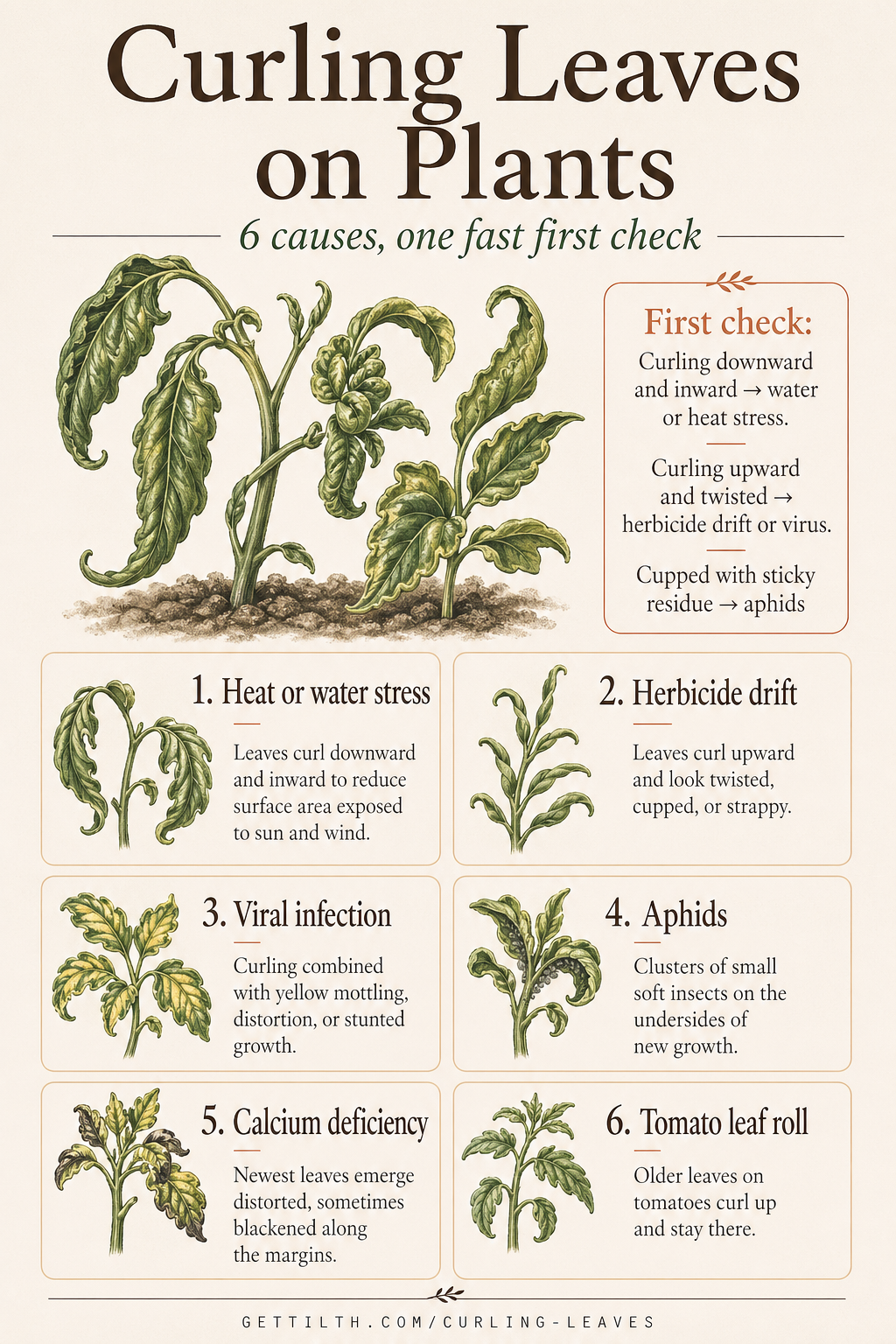
First check: which direction?
The single most useful question:
- Curling downward and inward → water or heat stress
- Curling upward and twisted → herbicide drift or virus
- Cupped with sticky residue → aphids
- New growth distorted → calcium deficiency or virus
Then ask: where on the plant?
- Oldest leaves curling → environmental cause
- Newest leaves curling → nutrient or pest
Likely causes
Heat or water stress (curling downward)
Pattern: Leaves curl downward and inward to reduce surface area exposed to sun and wind. Reverses when conditions improve.
Confirm: Hot day, dry-ish soil, or both. Plant looks better in the morning or after deep watering.
Fix: Deep watering. Mulch heavily to retain soil moisture. Add temporary shade cloth during heat waves above 90°F. Leaves uncurl when conditions normalize.
Herbicide drift (curling upward, twisted)
Pattern: Leaves curl upward and look twisted, cupped, or strappy. New growth comes out distorted. Often from a neighbor’s lawn treatment, drift from a windy spray, or from contaminated mulch (some commercial composts contain herbicide residue).
Confirm: Sudden onset; multiple plants affected (not just one). Distortion shows on new growth weeks after exposure. Tomatoes, beans, and grapes are most sensitive — they often show symptoms first.
Fix:
- Stop using contaminated mulch if that’s the source
- For drift exposure — there’s no fix; affected leaves won’t recover
- Plant may produce normal new growth once exposure ends, but may also be stunted permanently
- Identify the source — talk to neighbors about lawn treatment timing; check compost source
Viral infection (curling with mottling)
Pattern: Curling combined with yellow mottling, distortion, or stunted growth. Usually permanent — viruses can’t be cured.
Confirm: Mottled coloring (lighter and darker green patches) along with distortion. Plant fails to thrive normally.
Fix: Remove the plant. Viruses spread to other plants via insects (especially aphids and thrips). Don’t compost — bag and trash. Sanitize tools between plants if you’ve worked with infected material.
Aphids (cupped with sticky residue)
Pattern: Clusters of small soft insects (green, black, white, yellow) on the undersides of new growth. Sticky residue (honeydew) on leaves. Leaves curl around feeding sites.
Confirm: Turn the curled leaf over. You’ll see them. Often near growing tips or buds.
Fix:
- Strong water spray — knocks them off, often enough for light infestations
- Insecticidal soap — for persistent infestations
- Neem oil — for sustained control
- Encourage ladybugs — natural aphid predators
Calcium deficiency (distorted new growth)
Pattern: Newest leaves emerge distorted, sometimes blackened along the margins. Older leaves look fine. Most common on tomatoes (combined with blossom end rot on fruit), peppers, and other heavy fruiting plants.
Confirm: Only new growth is affected. Existing leaves are normal.
Fix:
- Consistent watering — calcium availability requires steady moisture, not actual soil deficiency
- Add calcium if soil tests low (lime, gypsum, or eggshells worked into soil)
- Don’t over-fertilize with nitrogen — competes with calcium uptake
- For tomatoes specifically, blossom end rot fixes itself once watering stabilizes
Tomato leaf roll (physiological)
Pattern: Older leaves on tomatoes curl up and stay there. The plant otherwise looks healthy. Often appears in summer after heat or pruning.
Confirm: Lower leaves curl; new growth is fine. Plant continues to flower and fruit normally.
Fix: Nothing. This is a physiological response to heat or pruning stress. Doesn’t affect production.
Plant-specific notes
- Tomato — physiological leaf roll is common and harmless. Curling new growth = calcium issue. Twisted distorted growth = herbicide drift.
- Pepper — aphids are the main curl cause. Check undersides of new leaves.
- Cucumber, Squash — viral infection (mosaic virus) causes curling and mottling; remove infected plants.
- Strawberries — strawberry leaf curl is caused by aphids; cyclamen mites cause similar damage.
- Beans — curling and stunted new growth almost always = herbicide drift. Beans are extremely sensitive.
When to worry vs. when not to
Don’t worry: Tomato leaf roll on otherwise healthy plants. Some afternoon downward curling on a hot day that reverses by evening.
Do worry: New growth coming out distorted (especially upward-twisted) — could be herbicide damage or virus, both serious. Mottled curling — viral. Sticky residue — active aphid infestation worth treating.
Related
- Watering problems — water stress causes
- Environmental stress — heat-induced curl
- Pests — aphids and mites
- Nutrients — calcium deficiency
- Diseases — viral causes
- The diagnosis guide — full diagnostic framework