THE GUIDE
Plant Nutrient Deficiencies — How to Diagnose and Fix
Most nutrient deficiencies present as some form of yellowing or distorted growth. The pattern tells you which nutrient. A PNW gardener's guide.
Plants need three nutrients in large amounts (nitrogen, phosphorus, potassium — N-P-K) and several in smaller amounts (calcium, magnesium, iron, and others). Most deficiencies present as some form of yellowing or distorted growth, and the pattern — which leaves, what color, where on the leaf — narrows the cause down quickly.
The most common PNW nutrient issue isn’t actually a deficiency. It’s pH lockout, where nutrients are present in soil but unavailable to plants because pH is wrong.
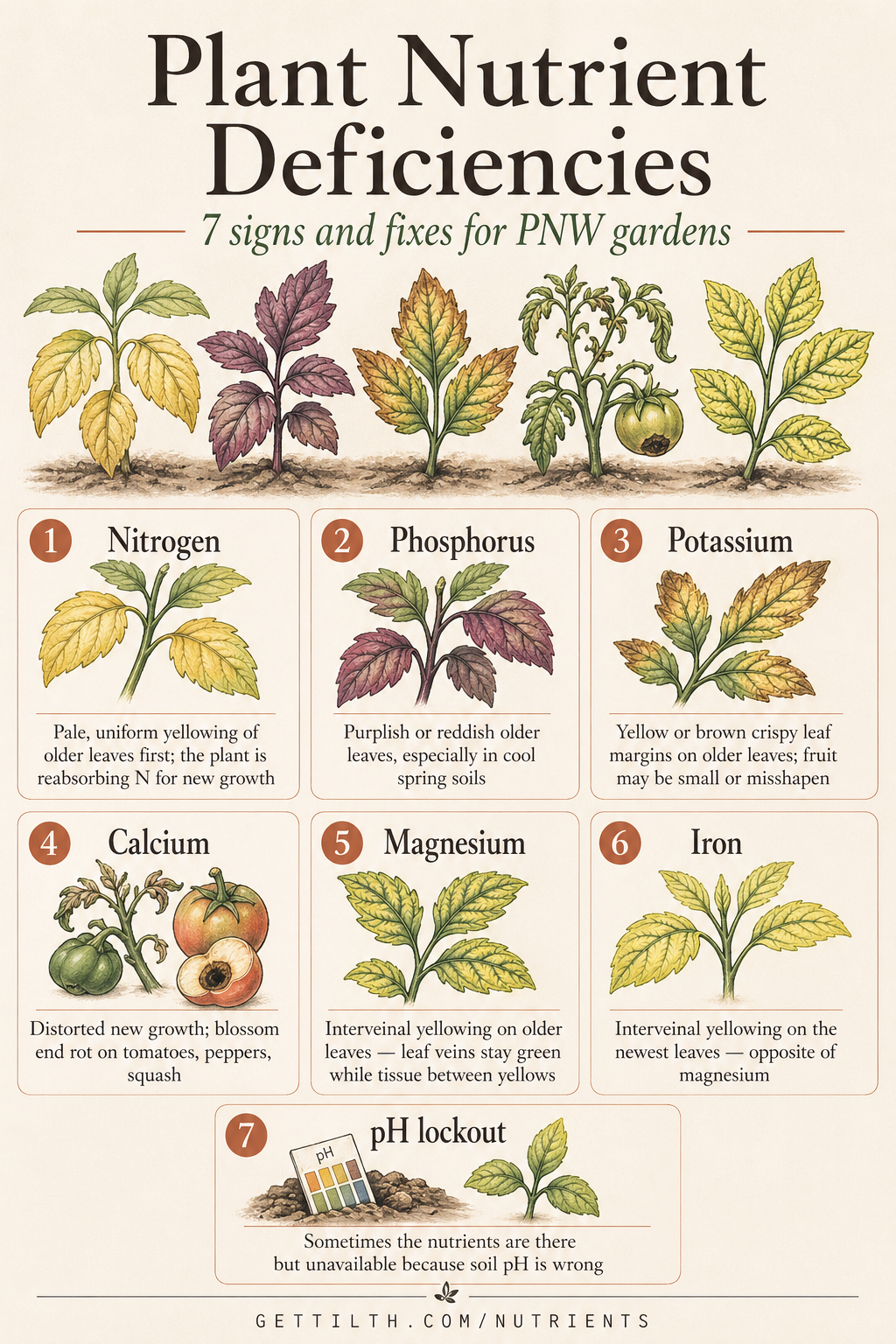
Common deficiencies and signs
Nitrogen
Pattern: Pale, uniform yellowing of older (bottom) leaves first; the plant is reabsorbing N for new growth.
Common situations: Beds that haven’t been amended in 1+ years; heavy-feeding crops late in the season (peppers, tomatoes, brassicas).
Fix: Side-dress with blood meal, fish emulsion, or compost. Effects in 1–2 weeks. For long-term: amend with compost in the off-season.
Phosphorus
Pattern: Purplish or reddish older leaves, especially in cool spring soils. Slow rooting, slow flowering.
Common situations: Cold soil reduces phosphorus availability even when present. Common in early spring before soil warms.
Fix: Bone meal at planting time. Soft rock phosphate for slow long-term release. Often resolves on its own as soil warms.
Potassium
Pattern: Yellow or brown crispy leaf margins on older leaves; fruit may be small or misshapen.
Common situations: Sandy soils that leach potassium; heavy harvests of fruit-bearing plants without fertilization.
Fix: Greensand, kelp meal, or wood ash (lightly — ash also raises pH). Comfrey leaf mulch is a slow K source for fruiting plants.
Calcium
Pattern: Distorted new growth; blossom end rot on tomatoes, peppers, squash (sunken black patch on the bottom of the fruit).
Common situations: Tomatoes especially. The classic confusion: blossom end rot looks like calcium deficiency but is almost always actually a calcium availability problem caused by inconsistent watering. Adding calcium when watering is erratic doesn’t fix the problem.
Fix:
- First: stabilize watering. Consistent moisture lets plants move calcium into developing fruit.
- If soil is genuinely calcium-deficient (test confirms): add lime, gypsum, or eggshells worked into soil.
- Don’t over-fertilize with nitrogen — competes with calcium uptake.
Magnesium
Pattern: Interveinal yellowing on older leaves — leaf veins stay green while tissue between yellows. Looks like a green-veined yellow leaf.
Common situations: Sandy soils; long-term heavy K fertilization (potassium and magnesium compete).
Fix: Epsom salts (magnesium sulfate) — 1 tablespoon per gallon of water, foliar spray or soil drench. Dolomite lime if soil is also acidic. Effects in 1–2 weeks.
Iron
Pattern: Interveinal yellowing on the newest leaves — opposite of magnesium. Common in alkaline soils.
Common situations: Acid-loving plants (blueberries, rhododendrons, hydrangeas) in soil that’s not acidic enough.
Fix: Address the underlying pH issue. Acidify with elemental sulfur (slow). Iron sulfate or chelated iron for short-term relief.
pH lockout (the common PNW issue)
Sometimes the nutrients are there but unavailable because soil pH is wrong. Most vegetables prefer pH 6.0–7.0. Outside that range, even well-fertilized soil produces deficient plants.
The classic PNW pH lockout case: blueberries with yellow leaves and green veins. The soil might have plenty of iron, but pH above 5.5 prevents the plant from absorbing it. Adding iron doesn’t fix the problem; lowering pH does.
How to fix
For acute issues (current season), the right amendment acts in 1–3 weeks:
- Nitrogen: blood meal, fish emulsion, side-dress with compost
- Phosphorus: bone meal worked into root zone
- Potassium: kelp meal, greensand, banana peels in soil
- Calcium: lime (also raises pH), gypsum (no pH effect), eggshells
- Magnesium: Epsom salts foliar spray
- Iron: chelated iron, iron sulfate (also acidifies)
For chronic problems (recurring across seasons):
- Soil test — county extension office or home kit ($15–30). Beats guessing. Tells you what’s actually deficient.
- Test pH — separately or as part of soil test. Adjust pH first; many “deficiencies” resolve when pH is right.
- Amend annually with 1–2 inches of compost worked into beds. Compost provides slow-release nutrients across the spectrum and improves soil structure.
- Crop rotation — different families have different nutrient demands. Rotating prevents soil exhaustion.
Foliar sprays (liquid kelp, fish emulsion) can buy time while soil amendments take effect — leaves absorb nutrients directly.
PNW-specific notes
PNW soil tends to be slightly acidic (pH 5.5–6.5) and often deficient in calcium because of long-term rainfall leaching. Common implications:
- Add lime every 2–3 years to most vegetable beds to maintain pH around 6.5 and replace leached calcium
- Test pH before planting acid-loving plants (blueberries, rhododendrons) — most native PNW soils are close to ideal but raised beds and amended soils may not be
- Don’t add lime to acid-loving plant beds — it pushes pH the wrong direction
Plant-specific notes
- Tomato — blossom end rot looks like calcium deficiency but is actually a watering problem. Fix the watering schedule first.
- Blueberries — yellow leaves with green veins almost always = iron deficiency from high pH. Acidify.
- Rhododendron — same pattern as blueberries.
- Pepper — yellow lower leaves later in season = nitrogen depletion as fruit set begins. Side-dress.
- Kale — heavy feeder; benefits from side-dressing during long fall and winter harvest.
- Garlic — light feeder; over-fertilization produces leafy plants with small bulbs.
Related
- Yellow leaves — most nutrient deficiencies present here
- Curling leaves — calcium deficiency causes new growth distortion
- Stunted plants — chronic deficiency limits growth
- The diagnosis guide — full diagnostic framework