THE GUIDE
Stunted Plant Growth — Why Isn't My Plant Growing?
Stunted growth is the hardest single symptom to diagnose because it's a comparison problem. A PNW gardener's guide to the most likely causes.
Stunted growth is the hardest single symptom to diagnose because it’s a comparison problem. You need to know what normal looks like for that plant under your conditions. The fastest way to answer is to compare to siblings — same plant, same bed, same age. If they’re all stunted, the cause is collective. If only some are, it’s individual.
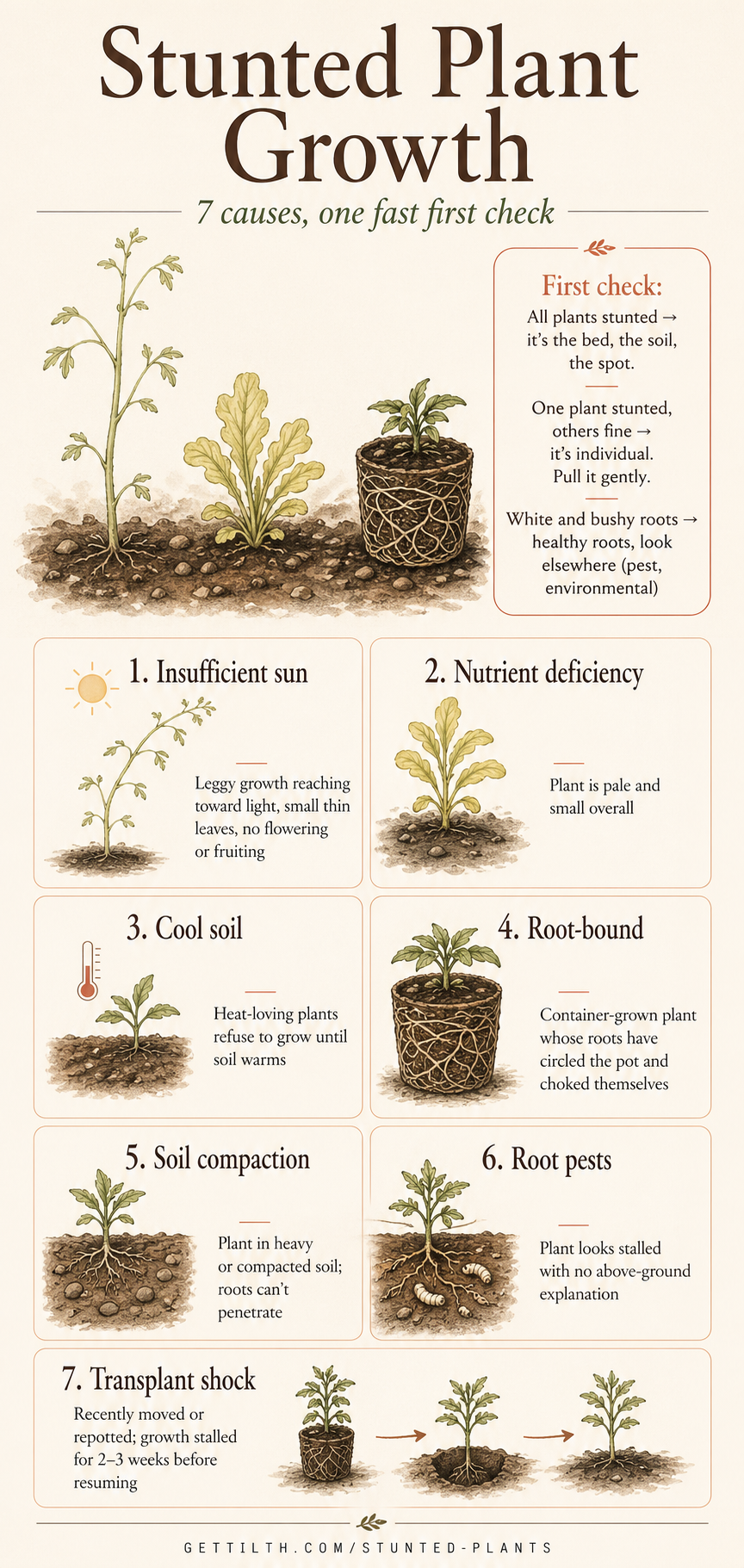
First check: compare to siblings
The single most useful question:
- All plants stunted → it’s the bed, the soil, the spot, or the season. Start with sun hours, soil temperature, and nutrient status.
- One plant stunted, others fine → it’s individual. Pull it gently and inspect the roots.
Then for individual plants:
- White and bushy roots → healthy roots, look elsewhere (pest, environmental)
- Brown, mushy, or chewed roots → root problem
- Tightly circled roots → root-bound (containers); loosen and replant
Likely causes
Insufficient sun
Pattern: Leggy growth reaching toward light, small thin leaves, no flowering or fruiting. Plant alive but not thriving.
Confirm: Count actual hours of direct sun in your spot during peak season. Less than 6 hours for fruiting plants is too little.
Fix:
- Move the plant to a sunnier spot if possible
- Switch crops — leafy greens and herbs handle 4 hours; tomatoes and peppers need 6+
- Prune surrounding shade — overhanging branches, etc.
Nutrient deficiency
Pattern: Plant is pale and small overall. Most often nitrogen — leaves are pale green or yellowing. Phosphorus deficiency shows as purple or reddish older leaves. Potassium shows as crispy leaf margins.
Confirm: Soil hasn’t been amended in 1+ years. Bed has had heavy crops without fertilization.
Fix: Side-dress with compost, fish emulsion, or balanced organic fertilizer. Soil test for chronic problems. See nutrient deficiencies for specifics.
Cool soil (PNW special)
Pattern: Heat-loving plants (peppers, tomatoes, eggplant, basil) refuse to grow until soil warms. Common in PNW spring; plants installed too early sit and sulk for weeks.
Confirm: Did you transplant before mid-May? Is soil temperature still under 60°F?
Fix:
- Wait for soil to warm naturally
- Black plastic mulch to pre-warm soil
- Row cover to add air temperature
- Patience — a tomato in 60°F soil overtakes a tomato in 50°F soil within 2 weeks
Root-bound (containers)
Pattern: Container-grown plant whose roots have circled the pot and choked themselves. Plant looks proportionally healthy but won’t grow.
Confirm: Tip the plant out of the pot. If you see a dense mat of circling white roots, it’s root-bound.
Fix:
- Move to larger pot with fresh soil
- Loosen the root ball before replanting — score with a knife or use fingers to break up the circle
- Severe cases — root prune (cut off the bottom inch of root mass)
Soil compaction
Pattern: Plant in heavy or compacted soil; roots can’t penetrate. Stunted with poor structure. Common in raised beds that get walked on or in unimproved clay.
Confirm: Push a screwdriver into the soil. If you can’t push it in 6+ inches with moderate pressure, soil is too compacted.
Fix:
- Amend with compost worked deeply into the bed
- Build raised beds in heavy clay
- Don’t walk on growing beds — use paths
- Cover crops (clover, vetch) over winter add organic matter and break compaction
Root pests
Pattern: Plant looks stalled with no above-ground explanation. Cutworms, root maggots, or grubs eating below the soil line.
Confirm: Pull the plant. Check for chewed roots, white grubs in the soil, or pinched stems at the soil line (cutworm damage).
Fix:
- Cutworms — collar each transplant with a paper or cardboard ring (extends 2 inches above and below soil line)
- Root maggots — row covers at planting prevent egg-laying
- Grubs — beneficial nematodes treat soil; takes a season
Transplant shock
Pattern: Recently moved or repotted; growth stalled for 2–3 weeks before resuming. Leaves may also yellow or droop.
Confirm: Was the plant transplanted recently? Especially in summer heat?
Fix: Wait. Most plants recover on their own within 3 weeks. Keep soil moist (not wet); don’t fertilize until growth resumes. For severe shock, provide temporary shade.
Plant-specific notes
- Tomato, Pepper — cool soil is the #1 PNW stunting cause. Wait for proper transplant time.
- Squash, Cucumber — direct seeding into cold soil rots seeds before they can germinate. Wait for soil warmth.
- Lettuce — bolting and bitterness are different from stunting; check temperatures.
- Blueberries — stunted growth with yellow leaves usually means soil pH is too high. Test and acidify.
- Rhododendron — stunted with brown leaves dropped at the petiole = root rot from waterlogged soil.
When to worry vs. when not to
Don’t worry: Newly transplanted plants pausing for 1–2 weeks. Heat-loving plants slow during cool spring weather (will resume when warmth arrives). Slow growth in established perennials in their first year (root development takes precedence over visible growth).
Do worry: All plants in a bed stunted (collective cause). A previously vigorous plant suddenly stops growing (acute problem). New plant doesn’t establish after 4+ weeks (planting problem or soil problem).
Related
- Sunlight — insufficient sun
- Nutrients — deficiencies
- Environmental stress — cool soil, transplant shock
- Pests — root pests
- Watering problems — root rot
- The diagnosis guide — full diagnostic framework