THE GUIDE
Growing Blueberries in the Pacific Northwest
How to grow blueberries in the PNW: cultivar selection, the acidic soil pH that's essential, why you need two cultivars for cross-pollination, and bird protection.
PNW is blueberry country. Soil pH and rainfall are nearly ideal — assuming you pick the right cultivar and protect the harvest from birds. The single most important success factor is soil pH below 5.5. Most native PNW soils are close, but raised beds and amended soils may not be. Test before planting.
Quick facts
- Plant: transplant young plants March–April or in fall. Plant 2+ different cultivars within 100 feet for cross-pollination.
- Sun: 6+ hours direct
- Water: 1–2 inches/week, consistent. Drip irrigation preferred.
- Soil: pH 4.5–5.5 (acidic — most plants need acidification), rich in organic matter
- Days to harvest: 1–2 years for first crop; full production in year 4–5
When to plant
Best planting windows:
- Early spring (March–April), as soon as soil can be worked
- Fall (October–November), with mulch protection through winter
Buy 2–3 year old container plants from a local nursery. Smaller plants establish but take longer to produce. Larger field-dug plants (5+ gallon) cost more and don’t establish dramatically faster.
Plant 2+ different cultivars within 100 feet. Blueberries cross-pollinate; a single plant produces poorly even though it’s technically self-fertile. Two different cultivars dramatically increase yield.
Cultivars that work
PNW-tested cultivars by harvest season:
Early (June–July):
- Duke — large berries, productive, the most reliable early variety
- Earliblue — early classic, smaller berries
- Patriot — semi-dwarf, very cold hardy
Mid-season (July):
- Bluecrop — the standard; productive, good flavor, widely adapted
- Blueray — large berries, good flavor
Late (August–September):
- Chandler — huge berries, exceptional flavor
- Elliott — late, productive, extends harvest
For best results: plant 2–3 cultivars across early/mid/late for a 6–8 week harvest window. Duke + Bluecrop + Chandler is a solid PNW combination.
Sun and soil
Full sun (6+ hours) for best production. Plants tolerate partial shade but produce significantly less.
Soil is where blueberries succeed or fail. Requirements:
- pH 4.5–5.5 — acidic. Test before planting.
- High organic matter — amend with peat moss, pine needles, or aged sawdust
- Well-draining — wet feet kill blueberries
- Cool, mulched — root systems are shallow and prefer cool soil
If your pH is above 5.5, acidify with elemental sulfur in the year before planting (incorporate 1 lb sulfur per 100 sq ft to lower pH by ~1 point). Pine needle mulch helps maintain acidity over time.
If your soil is heavy clay or alkaline, plant in raised beds with peat-amended soil instead of trying to amend native soil.
Watering
1–2 inches per week, consistent. Drip irrigation is ideal because blueberries don’t tolerate overhead watering well during fruit development (causes splitting).
Mulch with 3–4 inches of pine needles, wood chips, or sawdust. Mulch keeps roots cool, retains moisture, suppresses weeds, and slowly acidifies the soil.
Common problems
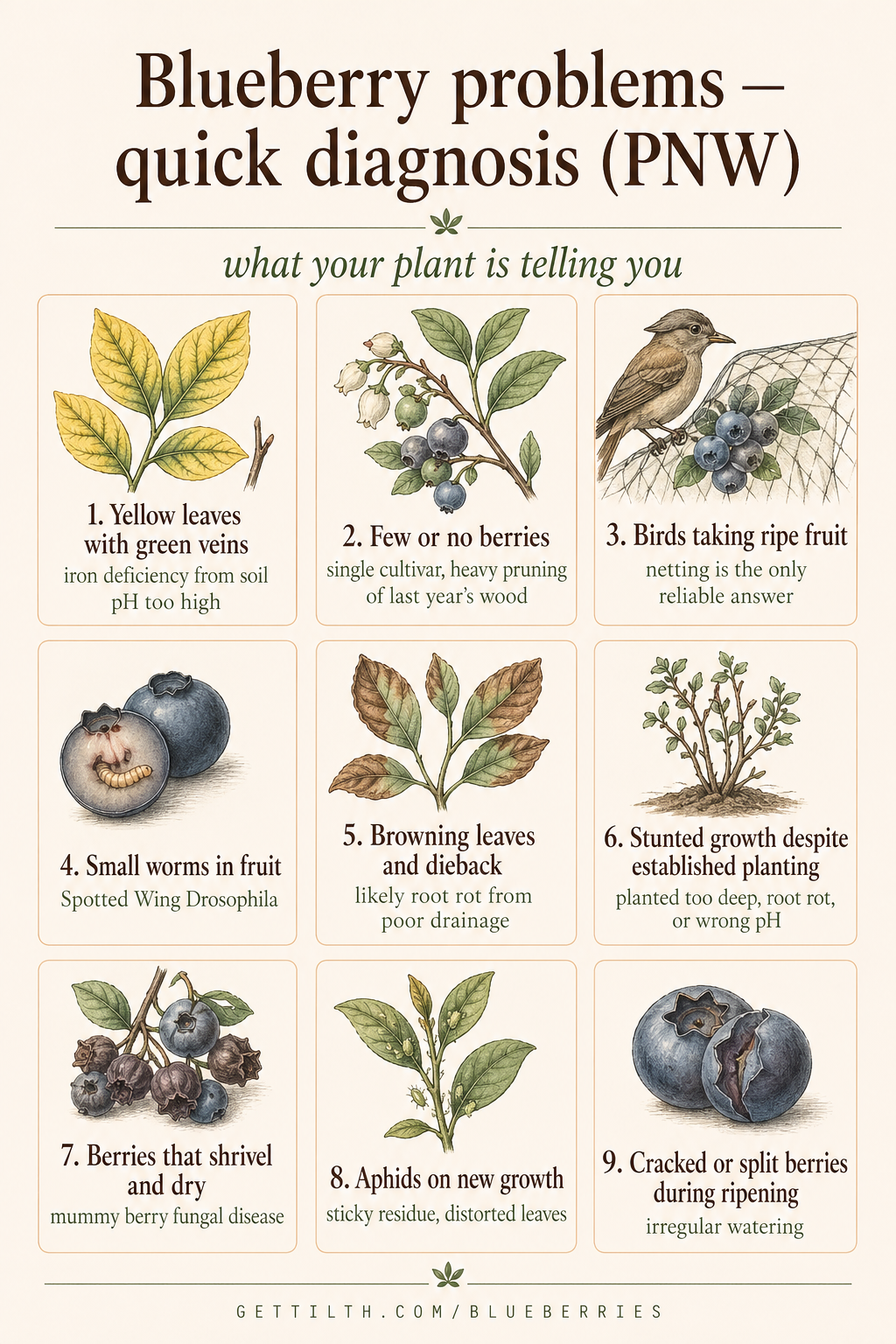
Nine most-asked-about blueberry problems in PNW gardens:
- Yellow leaves with green veins — iron deficiency from soil pH too high. Test and acidify with sulfur. The most common PNW blueberry problem and the most fixable.
- Few or no berries — single cultivar (need cross-pollination), heavy pruning of last year’s wood, or too-young plants (3+ years to good crop). Plant a second cultivar nearby.
- Birds taking ripe fruit — netting is the only reliable answer. Drape bird netting 2 weeks before berries start to ripen.
- Small worms in fruit — Spotted Wing Drosophila. Common PNW pest. Pick frequently and refrigerate immediately; drop infested berries in soapy water.
- Browning leaves and dieback — likely root rot from poor drainage. Improve drainage or replant on raised mound.
- Stunted growth despite established planting — planted too deep (crown buried), root rot, or wrong pH. Crown should be at soil level.
- Berries that shrivel and dry on the bush — mummy berry fungal disease. Remove all affected berries and ground litter; mulch with fresh material.
- Aphids on new growth — sticky residue, distorted leaves. Wash off with strong water; insecticidal soap if persistent.
- Cracked or split berries during ripening — irregular watering. Maintain consistent moisture during the fruit-development window.
Harvest
Berries are ready when they’re fully blue all over and pull off the bush easily with a gentle tug. Slightly underripe berries are still pink-tinged and will be tart.
Pick every 2–3 days during peak season. Refrigerate immediately — PNW summers are mild but room temperature is too warm for blueberry storage.
Annual production:
- Year 1: ~0 berries (focus on root establishment)
- Year 2: light crop
- Year 3: increasing crop
- Year 4–5+: full production, 5–10+ lbs per mature plant
Pruning
Blueberries fruit on last year’s wood. Pruning is light:
- Year 1–3: remove only weak or crossing branches; otherwise let plants establish
- Year 4+: in late winter, remove 1–2 of the oldest canes (5+ years old) to encourage new growth. Don’t prune more than 25% of the plant in any year.
Don’t prune in summer. Dormant pruning (January–February) is the standard.
Related plants
- Strawberries — similar acidic soil preference; can grow nearby
- Rhododendron — same acidic soil group; aesthetic and cultural pairing works well
- Lingonberries, huckleberries — related Vaccinium species that share growing conditions
For underlying patterns affecting blueberries (pH, drainage, bird pressure), see the diagnosis guide.