THE GUIDE
Why Are My Plant's Leaves Yellow?
Yellow leaves are the most-Googled plant problem — and they mean six different things depending on which leaves are yellow and how fast it happened. A PNW gardener's diagnostic guide.
Yellow leaves are the single most-Googled plant problem, and the answer almost always depends on three things: which leaves are yellow, how fast it happened, and what else is wrong with the plant. A tomato shedding a single bottom leaf is fine. A whole pepper plant going pale in two days is not. Same symptom, completely different problems.
This guide walks through the six common causes and how to tell them apart in under a minute.
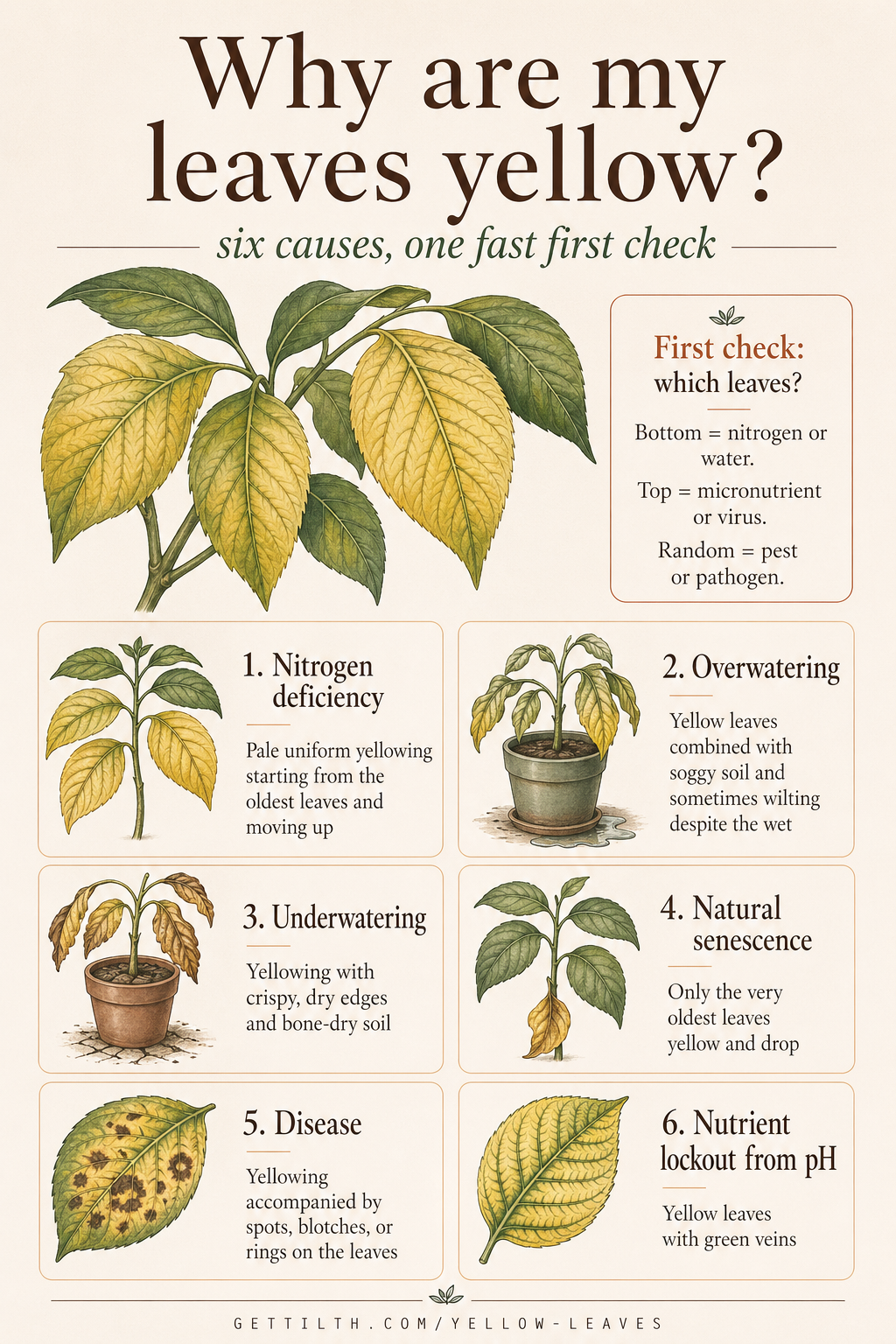
First check: which leaves?
Where on the plant the yellowing starts narrows the cause faster than any other observation:
- Bottom leaves first → nitrogen, water issues, or disease (early blight, septoria)
- Top leaves first → micronutrient deficiency (iron, manganese) or virus
- Random scattered yellowing → pest or pathogen
- Whole plant uniformly pale → severe nutrient deficiency, root damage, or transplant shock
Then check timing:
- Overnight → cold shock, transplant shock, sudden water issue
- Over weeks → nutrient deficiency, slow disease progression, natural senescence
These two questions usually narrow the cause to 1–2 candidates from the list below.
Likely causes
Nitrogen deficiency
Pattern: Pale uniform yellowing starting from the oldest (bottom) leaves and moving up. The plant is reabsorbing nitrogen from older tissue to feed new growth.
Confirm: Newer leaves at the top are deeper green than older leaves at the bottom. The plant looks generally undersized for its age.
Fix: Side-dress with compost, fish emulsion, or blood meal. Effects show within 1–2 weeks. For long-term: amend the bed with compost in the off-season.
Overwatering
Pattern: Yellow leaves combined with soggy soil and sometimes wilting despite the wet. Roots are suffocating because waterlogged soil has no oxygen.
Confirm: Stick a finger 2 inches into the soil — wet, cool, heavy. Smell the soil at the base of the plant — if it smells sour or “off,” anaerobic decomposition is happening.
Fix: Stop watering. Move container plants off standing water trays. Improve drainage in beds (compost amendment, raised beds in heavy clay). Severely overwatered plants with full root rot rarely recover; cut your losses.
Underwatering
Pattern: Yellowing with crispy, dry edges and bone-dry soil. Plant may also be wilting.
Confirm: Soil is dry 2 inches down. Plant is lighter than usual to lift (for containers).
Fix: Water deeply and slowly. For containers that have dried completely, soak the whole pot in a tub of water for 20 minutes — dry soil repels water at first. Mulch heavily to retain moisture going forward.
Natural senescence
Pattern: Only the very oldest leaves yellow and drop. The rest of the plant looks vigorous and is producing new growth normally.
Confirm: Check if the rest of the plant looks healthy. If yes, this is normal aging — the plant is shedding old leaves to invest energy in new growth. Especially common on kale, tomatoes, and other leafy plants.
Fix: Pull off the yellow leaves. Not a problem.
Disease
Pattern: Yellowing accompanied by spots, blotches, or rings on the leaves. Often spreading from the bottom of the plant upward, or from one branch outward.
Confirm: Look closely at the yellow leaves — are there brown spots with yellow halos (septoria)? Bullseye rings (early blight)? Greasy water-soaked spots (bacterial)?
Fix: Remove affected leaves. Don’t compost them — bag and trash. Improve air circulation; water at the soil line, not on the leaves. See diseases for treatment by disease type.
Nutrient lockout from pH
Pattern: Yellow leaves with green veins (chlorosis). Common on blueberries, rhododendrons, hydrangeas, and other acid-loving plants. Often signals iron deficiency caused by soil pH being too high (alkaline) for the plant.
Confirm: Test soil pH. If it’s above the plant’s preferred range (e.g., above 5.5 for blueberries), the soil contains iron but the plant can’t access it.
Fix: Acidify the soil with elemental sulfur (slow, takes a season) or apply iron sulfate / chelated iron for short-term relief. Pine needle mulch helps maintain acidity over time.
Plant-specific notes
The same yellow leaf means different things on different plants:
- Tomato — bottom yellow leaves usually water or nitrogen. Check soil moisture before fertilizing. If yellowing accompanies brown spots with yellow halos, suspect septoria.
- Kale — yellow lower leaves are usually natural senescence as the plant grows tall. Not a problem; pull them off.
- Blueberry — yellow leaves with green veins almost always means soil pH is too high. Acidify.
- Rhododendron — same as blueberry; yellow with green veins = iron deficiency from high pH.
- Pepper — yellowing later in the season is often nitrogen depletion as fruit set demands resources. Side-dress lightly.
When to worry vs. when not to
Don’t worry: A few yellow leaves at the bottom of a healthy, growing plant. Especially on kale, tomatoes, and other plants that naturally shed lower leaves over time.
Do worry: Rapid yellowing across most of the plant, yellowing combined with wilting or spots, or yellowing on a young plant that hasn’t established yet. Those are signs of a real problem worth diagnosing.
Related
- Watering problems — over and under
- Nutrient deficiencies — nitrogen, pH, micronutrients
- Diseases — fungal, bacterial, viral
- The diagnosis guide — for diagnostic framework and other symptoms