THE GUIDE
Growing Tomatoes in the Pacific Northwest
How to grow tomatoes in the PNW: when to plant, what varieties actually finish in cool summers, sun and water needs, and the common problems to watch for.
PNW tomatoes are a regional anxiety. Cool summers slow ripening, short nights drop fruit set, and a plant that would crank out beefsteaks in California’s Central Valley might give you four sad cherry tomatoes by September here. The fix isn’t more fertilizer or stronger sun — it’s choosing early-ripening varieties, planting on the right week, and letting go of the urge to grow Black Krims that won’t finish.
Quick facts
- Plant: transplant after May 1, once nights stay above 50°F
- Sun: 8+ hours direct (PNW sun is weaker per hour than at lower latitudes)
- Water: 1–2 inches/week, deep, mulched heavily
- Soil: pH 6.0–6.8, well-draining, compost-rich
- Days to harvest: 50–85 from transplant, variety-dependent
When to plant
Two dates matter: when to start indoors and when to transplant out.
Start indoors — mid-March to early April. Tomatoes need 6–8 weeks indoors to reach transplant size. Earlier than that and they outgrow their pots before it’s safe to plant out; later and you’re transplanting baby plants when bigger ones would have established faster.
Transplant outdoors — after May 1 in most of western Washington, or May 15 in cooler microclimates (north of Seattle, near water, in low-lying areas that frost late). The hard rule is nighttime lows above 50°F consistently. Cold soil stalls tomato growth — even if the air is mild, soil under 60°F keeps tomatoes sulking for weeks.
If May is unusually cool, hold off. A tomato transplanted into 45°F soil three weeks “early” will be passed within a week by a tomato transplanted into 60°F soil at the right time. Patience here costs you nothing.
Varieties that work in the PNW
This is the single most important PNW tomato decision. Beefsteaks and most Italian indeterminate types don’t ripen reliably in our cool summers. Choose early-ripening varieties (50–75 days from transplant) and you’ll have ripe tomatoes by August; choose late-ripening ones (80+ days) and you’ll be looking at green fruit in October.
PNW-tested favorites, ordered roughly by reliability:
- Sungold (60 days) — cherry, heavy producer, almost foolproof. The default PNW tomato.
- Sun Sugar (62 days) — yellow cherry, similar to Sungold but a touch sweeter
- Stupice (55 days) — Czech heirloom, small slicer, very early, prolific
- Early Girl (50 days) — red slicer, reliable workhorse
- Black Cherry (65 days) — flavorful purple-black cherry
- Cherokee Purple (75 days) — large dark heirloom, finishes in good years with a south-facing spot
- Brandywine (80 days) — risky in PNW; only attempt with a hot summer and a sheltered position
- Beefsteak / Mortgage Lifter / most Italian types — skip. They won’t finish.
For a productive bed, plant 2 cherries (Sungold + one other) and 2 slicers (Stupice + Cherokee Purple or Early Girl). You’ll get steady cherries from July onward and slicers in August.
Sun and soil
Tomatoes want full sun. In PNW terms, that’s 8+ hours of direct light during peak summer (June–August). Less than 6 hours and you’ll get a leggy plant with few fruits. Position tomatoes against a south-facing wall or fence if you can — reflected heat from siding or stone helps significantly.
Soil prep matters more than fertilizing later. Tomatoes are heavy feeders but they hate excess nitrogen, which produces leafy plants with no fruit. The right approach: amend the bed with 2–3 inches of compost worked in 6 inches deep before planting. Add a balanced organic fertilizer (NPK around 5-5-5) at planting. Don’t side-dress with high-nitrogen fertilizer once the plant is established — it’ll grow leaves at the expense of tomatoes.
pH should sit between 6.0 and 6.8. PNW soil tends to run slightly acidic, which is fine, but if your beds are below 5.8, add lime in the fall to bring it up by spring.
Watering
Tomatoes want deep, consistent watering, not frequent shallow watering. Aim for 1–2 inches per week, delivered in 1–2 deep waterings rather than daily sprinkling. Shallow watering encourages shallow roots, which crash the next time you skip a day.
The crucial rule: water at the soil line, never on the leaves. Wet leaves invite septoria leaf spot and early blight, both endemic to PNW tomato beds. Drip irrigation, soaker hoses, or careful hand-watering at the base all work. Overhead sprinklers do not.
Mulch heavily — 2–3 inches of straw, leaves, or compost — to retain soil moisture and even out the swings between dry stretches and rainy days. Mulch also stops soil from splashing onto leaves, which is the main vector for fungal disease.
Common problems
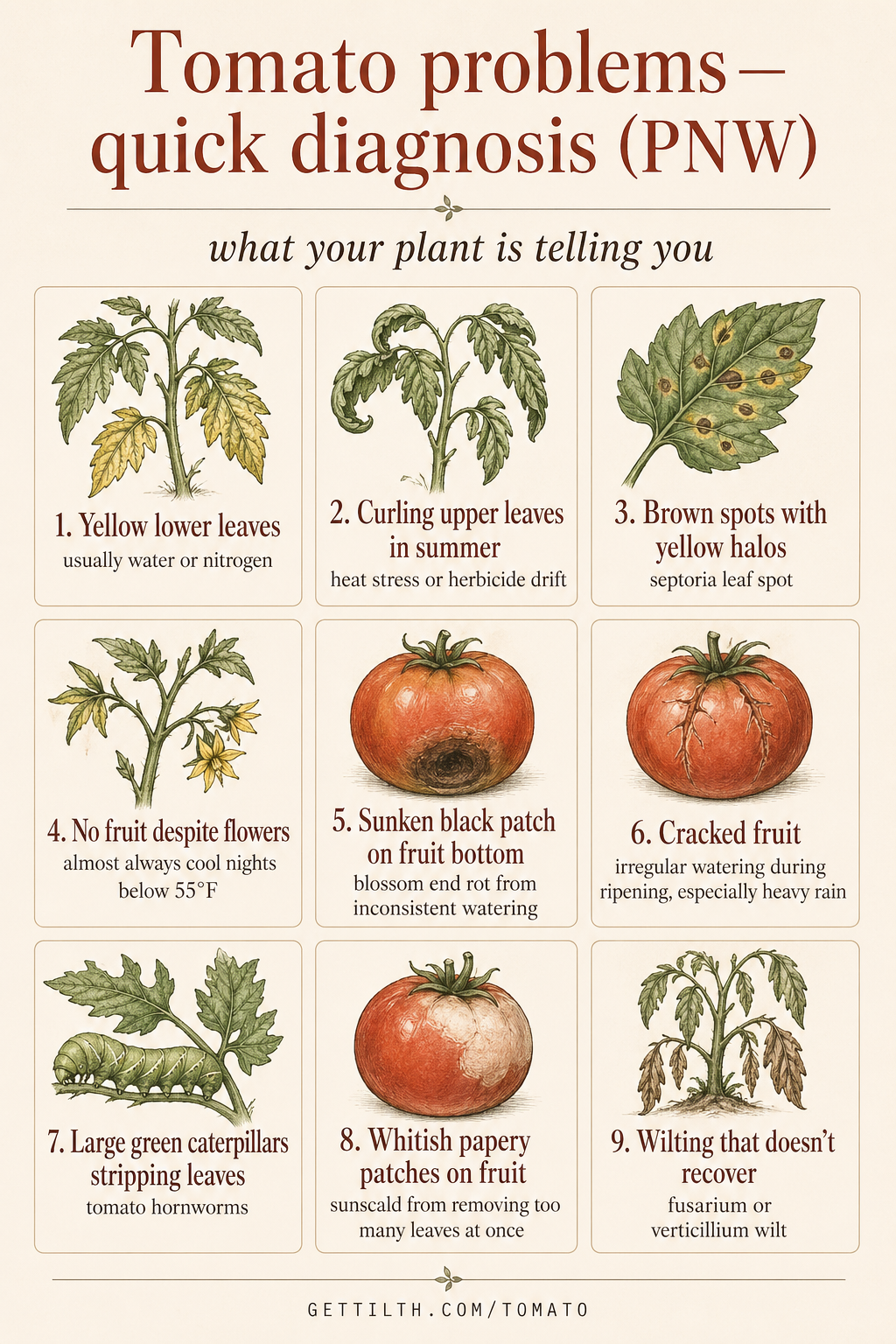
Nine most-asked-about tomato problems in PNW gardens:
- Yellow lower leaves — usually water or nitrogen. Check soil moisture before fertilizing.
- Curling upper leaves in summer — heat stress or herbicide drift. Reverses when conditions improve.
- Brown spots with yellow halos — septoria leaf spot. Remove affected leaves at the bottom and stop overhead watering.
- No fruit despite flowers — almost always cool nights below 55°F (PNW special). Confirm temps before assuming the plant is sick.
- Sunken black patch on fruit bottom — blossom end rot from inconsistent watering.
- Cracked fruit — irregular watering during ripening, especially heavy rain on dry plants. Mulch to even out moisture swings.
- Large green caterpillars stripping leaves — tomato hornworms. Hand-pick (use gloves; harmless but unpleasant). Look for frass on leaves to find them.
- Whitish papery patches on fruit — sunscald from removing too many leaves at once. Don’t over-prune the canopy that shades fruit.
- Wilting that doesn’t recover — fusarium or verticillium wilt. Cut a stem near the base; brown streaks inside confirm. Remove infected plants.
The most important tomato-specific gotcha: blossom end rot is a calcium availability problem, not a calcium deficiency. It comes from inconsistent watering, which prevents the plant from moving calcium into developing fruit. Adding calcium to the soil won’t help if your watering is erratic. Fix the watering schedule and the problem usually resolves.
Harvest
Tomatoes are ready when they color up fully — red varieties go from green to red, yellow varieties to yellow, dark types to deep purple-black. The fruit should be slightly soft to the touch but not mushy.
In PNW summers, ripening slows dramatically once nighttime lows drop below 55°F (typically late August into September). At that point you have two options:
- Leave them on the vine. They’ll ripen slowly in place, but late blight risk is rising.
- Pick them green and ripen indoors. Once tomatoes are full-sized and starting to color, they’ll finish on a counter. Doesn’t taste as good as vine-ripened, but beats losing them to frost.
When the first frost is forecast, harvest everything green-or-better and bring it inside. Tomatoes turn to mush below 32°F.
Related plants
- Pepper — same family (Solanaceae), similar requirements but even more cold-sensitive
- Squash & zucchini — different family but competes for the same warm-season bed space
- Basil — classic companion, loves the same heat and water schedule
- Marigold — companion plant; may help repel some pests
For the underlying watering, nutrient, and disease patterns that affect tomatoes (and most other vegetables), see the diagnosis guide.