THE GUIDE
Spots on Plant Leaves — How to Diagnose
Spots on plant leaves are usually fungal, sometimes bacterial, occasionally just sunscald. The color and pattern matter more than the size. A PNW gardener's guide.
Spots on plant leaves are usually fungal, sometimes bacterial, and occasionally just sunscald or hard-water mineral residue. The color, texture, and pattern matter more than the size — and they’re usually enough to identify the disease without a lab test. This guide covers the common spot types in PNW gardens.
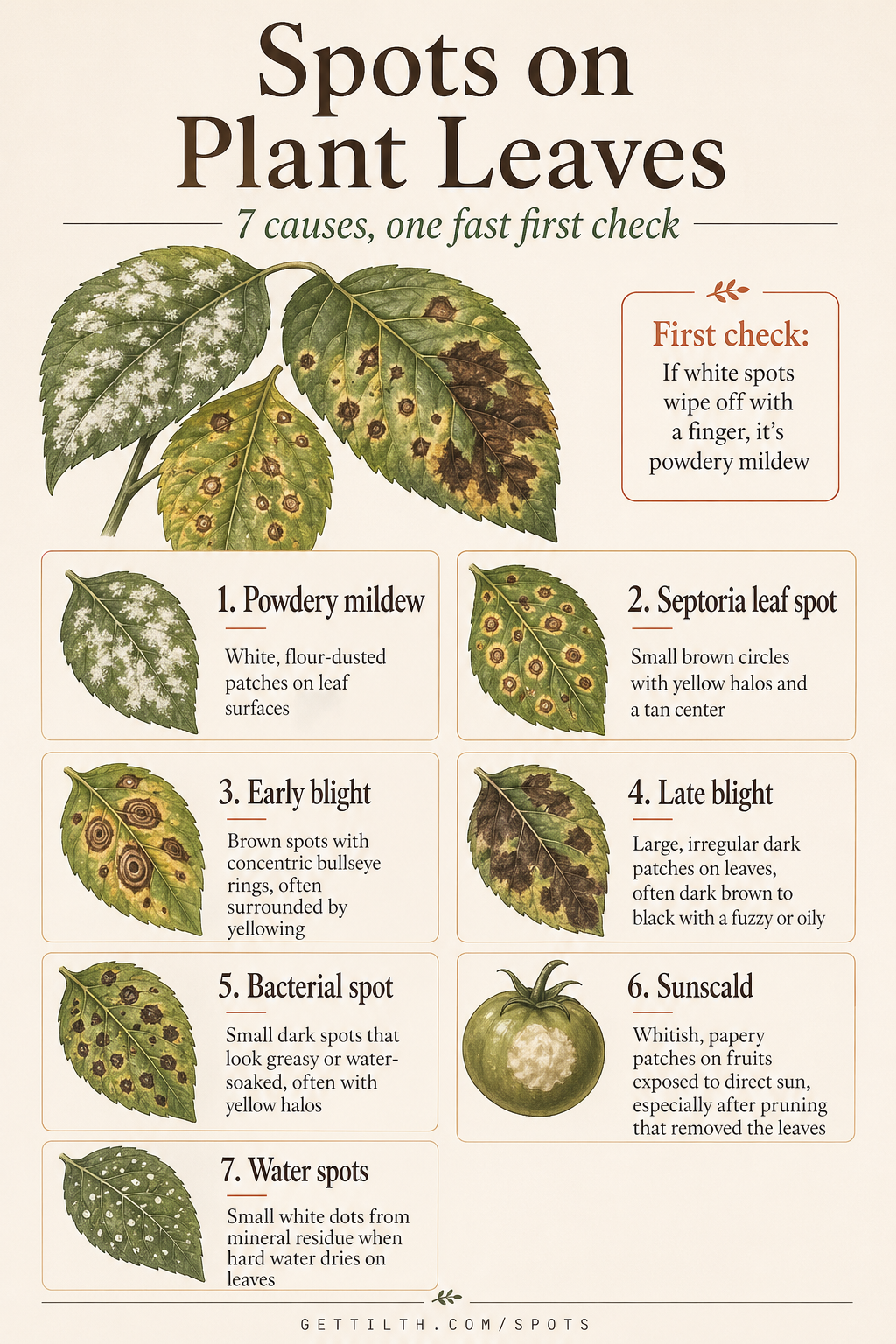
First check: try to wipe a white spot off
If white spots wipe off with a finger, it’s powdery mildew. If they don’t wipe and look wet/greasy, it’s bacterial. If brown spots have rings, it’s a specific fungal disease. The patterns are recognizable once named.
Then ask: does the spot have a halo? A bullseye? Is it concentrated on one part of the plant?
Likely causes
Powdery mildew (white)
Pattern: White, flour-dusted patches on leaf surfaces. Wipes off with a finger. Common on squash, zucchini, cucumber, beans, zinnias. Nearly guaranteed in PNW humidity by August.
Confirm: White coating that comes off when touched. Often starts on lower or shaded leaves and spreads.
Fix:
- Improve air circulation — prune crowded interior leaves
- Water at soil level only — never overhead
- Remove affected leaves early before it spreads widely
- Milk spray — 1 part milk to 9 parts water, sprayed weekly. Surprisingly effective as a preventive
- Sulfur or potassium bicarbonate sprays for advanced infections
- Accept some loss — powdery mildew on PNW squash is essentially inevitable. It reduces production but doesn’t kill plants.
Septoria leaf spot (small brown circles with yellow halos)
Pattern: Small brown circles with yellow halos and a tan center. Spreads from the lowest leaves upward. Common on tomatoes, almost guaranteed in PNW.
Confirm: Small spots (under 1/4 inch) with distinct yellow halo. Multiple spots per leaf; spreads up the plant over weeks.
Fix:
- Remove affected leaves immediately — don’t compost, bag and trash
- Mulch heavily — prevents soil splash, the main vector
- Water at soil level only
- Improve air circulation — prune lower branches
- Copper sprays — slow spread but won’t cure existing damage
Early blight (bullseye rings)
Pattern: Brown spots with concentric bullseye rings, often surrounded by yellowing. Common on tomatoes and potatoes. Spreads from bottom of plant upward.
Confirm: The bullseye pattern is distinctive — concentric circles within each spot.
Fix: Same as septoria. Remove affected leaves, mulch, soil-level watering, copper for severe cases. Crop rotation matters — don’t plant tomatoes or potatoes in the same bed for 3+ years if you’ve had blight.
Late blight (large irregular dark patches)
Pattern: Large, irregular dark patches on leaves, often dark brown to black with a fuzzy or oily appearance. Spreads quickly — can defoliate a plant in days. Tomatoes and potatoes are vulnerable. The most serious garden disease.
Confirm: Rapid spread (days, not weeks). Damp gray fuzz on leaf undersides. Dark patches turn fruit black quickly.
Fix:
- Remove and destroy entire affected plants — late blight spreads on the wind and can wipe out a neighborhood’s tomato crop
- Don’t compost infected material — bag and trash
- Don’t replant tomatoes or potatoes in the same bed for 3+ years
- Resistant varieties — Mountain Magic, Defiant, Plum Regal for tomatoes
PNW late blight is most common in cool, wet summers. Some years it doesn’t show up; others it’s everywhere.
Bacterial spot
Pattern: Small dark spots that look greasy or water-soaked, often with yellow halos. Doesn’t wipe off. Spreads fast in warm wet weather.
Confirm: Wet/greasy appearance distinguishes from fungal spots. Spots may eventually become angular (limited by leaf veins).
Fix:
- Remove affected leaves
- Don’t water from above
- Copper sprays can slow spread
- Crop rotation — bacterial spot persists in soil
- Sanitize tools between plants
Sunscald (whitish papery patches on fruit)
Pattern: Whitish, papery patches on fruits exposed to direct sun, especially after pruning that removed the leaves shading them. Common on tomatoes, peppers.
Confirm: Damage is on fruit, not leaves. Always on the sun-facing side. Often follows aggressive pruning.
Fix: Don’t prune leaves that shade fruit. Use shade cloth during heat waves above 90°F if fruit is exposed. Damaged fruit is still edible — cut away the affected spot.
Water spots (small white dots)
Pattern: Small white dots from mineral residue when hard water dries on leaves. Cosmetic only.
Confirm: Water spots appear where droplets dried. No tissue damage underneath.
Fix: Cosmetic; harmless. Switch to soil-level watering to prevent.
Plant-specific notes
- Tomato — septoria leaf spot is nearly universal in PNW; early and late blight occur in some years. Watch the lower leaves first.
- Squash, Cucumber — powdery mildew is essentially guaranteed by mid-summer.
- Zinnia (or any flower) — powdery mildew is the dominant disease on most PNW annuals.
- Blueberry — leaf spot diseases occur but rarely serious; check soil pH first if leaves look bad (more likely a chlorosis problem).
- Pepper — bacterial spot can be a significant problem in wet years.
When to worry vs. when not to
Don’t worry: A few spots on lower leaves of a healthy plant; powdery mildew on squash in August (annoying but not killing); minor sunscald on a few fruits.
Do worry: Late blight (dark spreading patches), spots covering more than a third of leaves, spots progressing rapidly, or any spot disease on a young plant.
Related
- Diseases — full disease taxonomy and prevention
- Environmental stress — sunscald lives here
- The diagnosis guide — full diagnostic framework