THE GUIDE
Growing Dahlias in the Pacific Northwest
How to grow dahlias in the PNW: when to plant tubers, slug protection at sprout time (the make-or-break decision), and whether to lift or leave tubers over winter.
Dahlias are Seattle’s flower. The PNW climate suits them — long mild summers, gentle frosts, manageable winters. The dominant problem is slugs, which can destroy a dahlia at sprout time before you’ve even seen it emerge. Protect at sprout time and the rest is easy.
Quick facts
- Plant: plant tubers in May, after soil reaches 60°F. Plant 4–6 inches deep, eyes facing up.
- Sun: 6+ hours direct
- Water: deep weekly once established; less in early growth
- Soil: pH 6.0–7.0, well-draining
- Days to harvest: 60–90 days from planting to first blooms
When to plant
Dahlias need warm soil to sprout. Don’t plant before mid-May or tubers will sit and rot.
Plant tubers — May to early June, after soil reaches 60°F. In coastal PNW, this is usually mid-May; in cooler microclimates, late May.
Pre-sprouting indoors — for an earlier start, pot tubers in containers in April, keep indoors until they sprout, then transplant outdoors in May. Adds 4–6 weeks to the bloom window.
Planting depth: 4–6 inches deep. Lay tubers horizontally with the eye (growth point) facing up. Water once at planting, then don’t water again until you see sprouts — pre-sprout watering rots tubers.
Varieties that work
Almost any dahlia variety grows in PNW. Choices are aesthetic, not climatic. A few notes:
Cut flower types:
- Café au Lait — large dinner-plate, classic PNW wedding flower
- Karma series — bred specifically for cutting, long stems
- Cornel — small ball dahlia, productive, dark red
Compact / border types:
- Mystic series — short bushy plants with dark foliage
- Gallery series — patio dahlias, no staking needed
Dinnerplate (10+ inch blooms):
- Café au Lait, Thomas Edison, Kelvin Floodlight — show-stoppers, need staking
For first-time growers: start with 3–5 tubers of different varieties to see what you like. Local PNW dahlia farms (Floret, Swan Island, Triple Wren) have huge selections and ship in spring.
Sun and soil
Full sun (6+ hours) for best blooms. Less light produces leggy plants with fewer flowers.
Soil should be well-draining and moderately fertile. Amend with 2 inches of compost worked in. Don’t over-fertilize with nitrogen — it produces leafy plants with fewer blooms (the “no blooms despite leafy growth” problem).
pH 6.0–7.0 is ideal. PNW soil is generally fine without amendment.
Watering
At planting: water once, then leave dry until sprouts emerge.
During early growth: water sparingly. Dahlia tubers can rot in wet soil before roots establish.
Once established (mid-July onward): deep weekly watering. 1 inch per week is plenty.
Mulch with bark or leaf compost to retain moisture and suppress weeds.
Common problems
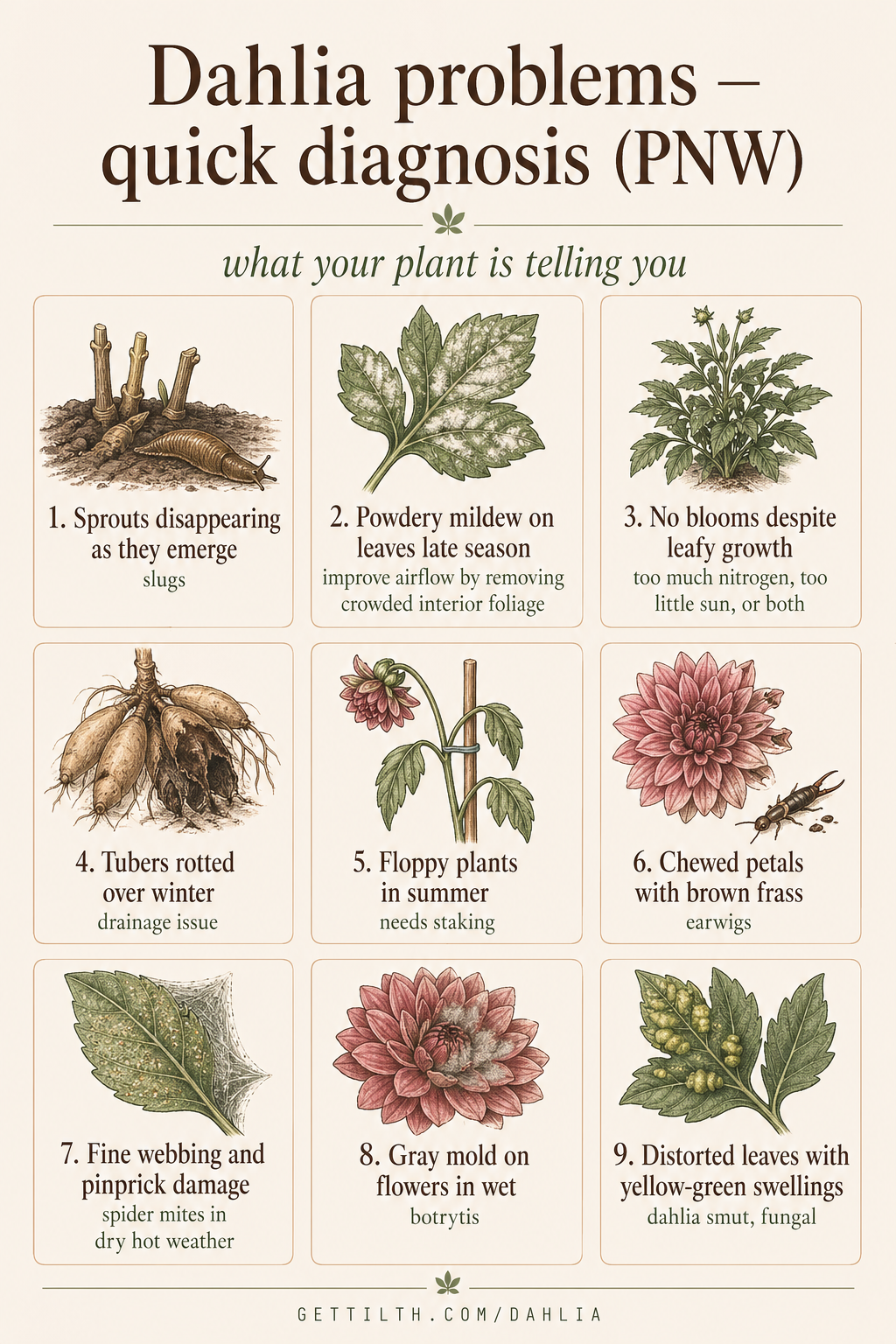
Nine most-asked-about dahlia problems in PNW gardens:
- Sprouts disappearing as they emerge — slugs. The dominant PNW dahlia issue. Iron phosphate (Sluggo) at planting site, beer traps, or copper barriers. Reapply after rain.
- Powdery mildew on leaves late season — improve airflow by removing crowded interior foliage. Mostly cosmetic.
- No blooms despite leafy growth — too much nitrogen, too little sun, or both. Reduce fertilizer; relocate if shaded.
- Tubers rotted over winter — drainage issue. Lift in November and store dry, or plant in raised beds.
- Floppy plants in summer — needs staking. Tall varieties need stakes 3–4 feet tall, set at planting time so the plant grows up through them.
- Chewed petals with brown frass in flowers — earwigs. Set traps (rolled newspaper or hose pieces at soil level); shake into soapy water in the morning.
- Fine webbing and pinprick damage on leaves — spider mites in dry hot weather. Increase humidity; insecticidal soap.
- Gray mold on flowers in wet weather — botrytis. Remove affected blooms; improve airflow; deadhead spent flowers regularly.
- Distorted leaves with yellow-green swellings — dahlia smut, fungal. Remove affected leaves; rotate planting site if persistent.
Bloom care
Pinch the center growing tip when plants are 12 inches tall. This forces branching and produces a bushier plant with more blooms. Skip if you want the tallest possible plant.
Cut flowers frequently. Dahlias are cut-and-come-again — the more you harvest, the more they bloom. Cut deep into the stem (down to the next pair of leaves) for longest vase life.
Remove spent blooms. Don’t let dahlias go to seed. Deadheading channels energy back into more flowers.
Winter care
PNW winters are mild enough that mulched-in-place tubers often survive. But lifting is safer.
Lift after first hard frost (usually November in lowland PNW). Cut stems back to 6 inches, dig tubers carefully (they bruise), brush off soil but don’t wash, and let them dry for a day.
Store in peat moss, vermiculite, or sawdust at 40–50°F (an unheated garage or basement works in PNW). Check monthly for rot or shriveling — mist with water if shriveling, remove rotting tubers.
Replant in May after dividing larger clumps into individual tubers (each must have at least one eye to grow).
If you choose to leave tubers in the ground: cut stems to 6 inches, mulch heavily (6+ inches of leaves or straw), and hope for a mild winter. Works in 4 out of 5 PNW years.
Related plants
- Other late-summer flowers — zinnias, cosmos, sunflowers; share growing conditions
- Hydrangea — different cultivation but flowers in the same window
- Salvia, snapdragons — companion border plants
For underlying patterns affecting dahlias (slugs, drainage, bloom failure), see the diagnosis guide.