THE GUIDE
Growing Hydrangeas in the Pacific Northwest
How to grow hydrangeas in the PNW: bloom color and soil pH, when to prune (the make-or-break decision), and which type of hydrangea you actually have.
Hydrangeas thrive in PNW conditions — moist, mild, partially shaded. The most-asked questions are about bloom color (depends on soil pH) and why didn’t it bloom this year (almost always wrong-time pruning). The hard part is knowing which type of hydrangea you have, because pruning rules differ.
Quick facts
- Plant: transplant fall or early spring
- Sun: 3–6 hours; morning sun + afternoon shade is ideal in PNW
- Water: 1–1.5 inches/week, deep — hydrangeas wilt visibly when thirsty
- Soil: pH 5.0–6.5 (acidic for blue, alkaline for pink), rich in organic matter
- Bloom window: June through September depending on type
Know your type (this matters)
Four common hydrangea types in PNW gardens. Pruning rules differ for each — getting this wrong is why “my hydrangea didn’t bloom” is the most-asked PNW hydrangea question.
Mophead and Lacecap (Hydrangea macrophylla) — the classic blue/pink hydrangea. Big round or flat flower clusters. Blooms on old wood (last year’s growth). Prune only immediately after blooming. Pruning in fall, winter, or spring removes next year’s flower buds.
Smooth (Hydrangea arborescens, including Annabelle) — large white snowball blooms. Blooms on new wood. Prune in late winter or early spring.
Panicle (Hydrangea paniculata, including Limelight, Pinky Winky) — cone-shaped white-to-pink blooms. Blooms on new wood. Prune in late winter.
Oakleaf (Hydrangea quercifolia) — distinctive oak-shaped leaves, white panicle blooms, fall color. Blooms on old wood. Prune only after blooming.
If unsure which you have, don’t prune. Watch for a season — note when it blooms and what the leaves look like — then identify and prune appropriately.
When to plant
Best windows:
- Fall (September–November) — establishes through wet PNW winter
- Early spring (March–April) — before active growth
Container plants establish faster than bare-root. Standard 1–3 gallon nursery plants are the easiest start.
Cultivars that work
PNW hydrangeas are abundant. A few starting points:
Mophead/Lacecap (color-changing):
- Endless Summer series — rebloomers, more reliable in PNW
- Nikko Blue — classic blue mophead
- Twist-n-Shout — lacecap, dependable
- Penny Mac — heavy bloomer
Smooth (white):
- Annabelle — large white blooms, very reliable
- Incrediball — sturdier stems than Annabelle
- Invincibelle Spirit — pink Annabelle relative
Panicle (cone-shaped):
- Limelight — chartreuse-white blooms
- Pinky Winky — pink-tipped white blooms
- Bobo — compact panicle, 3 ft tall
Oakleaf:
- Snow Queen — large white blooms, excellent fall color
- Ruby Slippers — compact, blooms turn pink
Sun and soil
Sun: 3–6 hours, with afternoon shade ideal in PNW. Too much direct afternoon sun causes wilt and leaf scorch. Too little shade reduces flowering.
Soil: rich, well-draining, organic. Amend with 2–3 inches of compost worked in.
pH affects bloom color for mophead and lacecap types only:
- Acidic soil (pH below 6.0) → blue blooms
- Alkaline soil (pH above 6.5) → pink blooms
- Neutral (6.0–6.5) → purple or mixed
Most PNW soil is acidic enough to produce blue naturally. To force pink: add lime to raise pH. To deepen blue: add aluminum sulfate or sulfur. White hydrangeas (Annabelle, Limelight) are unaffected by pH.
Watering
Hydrangeas are dramatic about water stress. They wilt visibly when thirsty — the leaves droop conspicuously. Don’t ignore it; deep watering recovers them within hours.
1–1.5 inches per week, deep watering. Mulch with bark or compost to retain moisture.
In PNW summers, hydrangeas in afternoon sun positions may need more frequent watering than the schedule suggests. Watch for wilting and water before it becomes severe.
Common problems
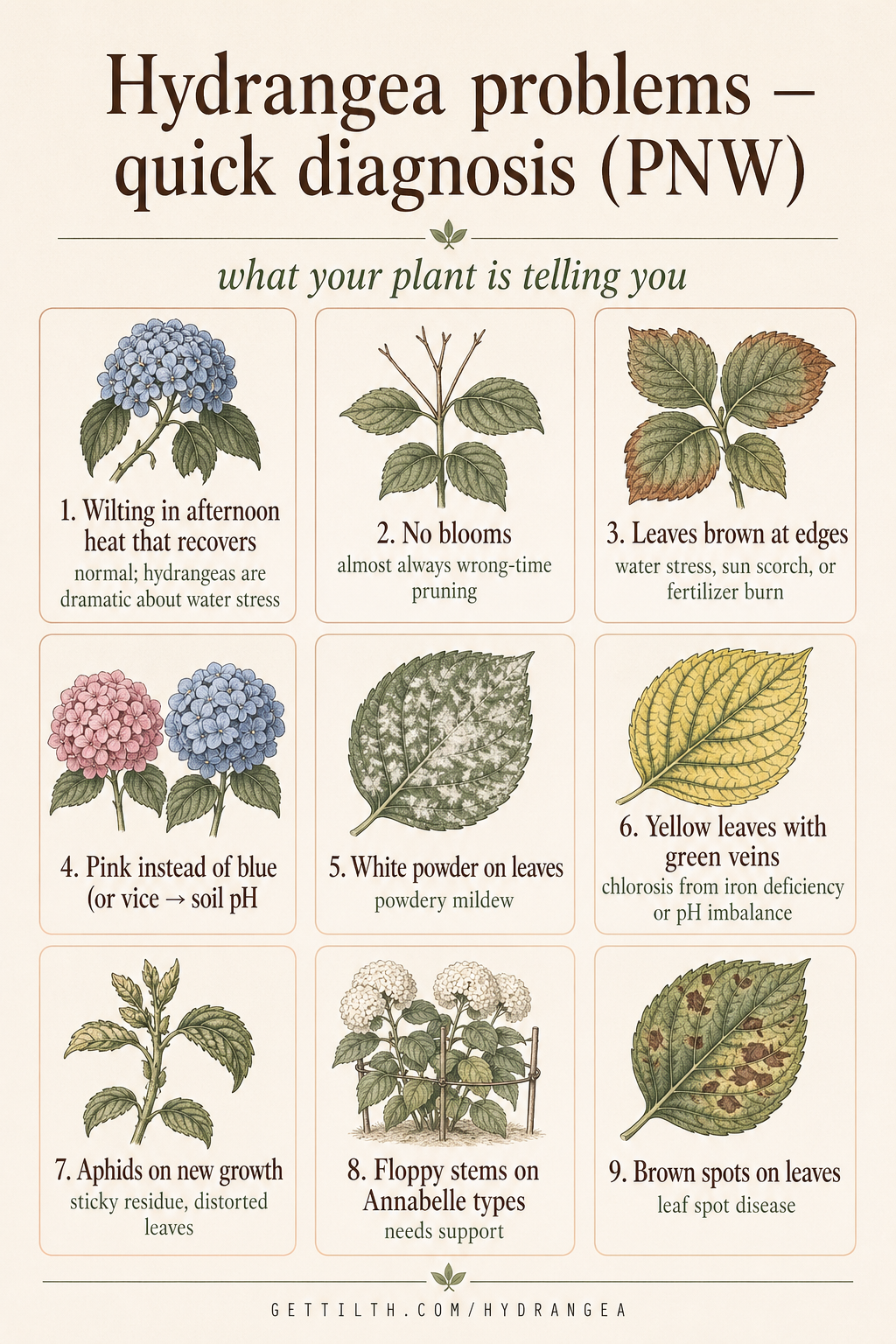
Nine most-asked-about hydrangea problems in PNW gardens:
- Wilting in afternoon heat that recovers overnight — normal; hydrangeas are dramatic about water stress. Water deeply if soil is dry; ignore if soil is moist.
- No blooms — almost always wrong-time pruning. Mophead, lacecap, and oakleaf bloom on old wood; pruning in fall removes next year’s buds. Other causes: late frost killed buds, plant too young, or insufficient sun.
- Leaves brown at edges — water stress, sun scorch, or fertilizer burn.
- Pink instead of blue (or vice versa) — soil pH. Adjust with aluminum sulfate (toward blue) or lime (toward pink). Takes a season to fully shift.
- White powder on leaves — powdery mildew. Improve airflow; don’t water overhead.
- Yellow leaves with green veins — chlorosis from iron deficiency or pH imbalance. Acidify soil for blue varieties; supplement iron.
- Aphids on new growth — sticky residue, distorted leaves. Wash off with strong water; insecticidal soap if persistent.
- Floppy stems on Annabelle types — needs support. Sturdier cultivars (Incrediball, Limelight) have stronger stems; or use grow-through grids.
- Brown spots on leaves — leaf spot disease. Remove affected leaves; improve airflow; water at soil level only.
Pruning (by type)
Recap with the critical rule:
| Type | When to prune | Why |
|---|---|---|
| Mophead, lacecap | Immediately after blooming (June–July) | Blooms on old wood; later pruning removes next year’s buds |
| Oakleaf | Immediately after blooming | Same — old wood bloomer |
| Smooth (Annabelle) | Late winter (February) | Blooms on new wood |
| Panicle (Limelight) | Late winter (February) | Blooms on new wood |
For mophead and lacecap, light pruning only — remove spent flowers, dead wood, and crossing branches. Hard pruning eliminates blooms.
For smooth and panicle types, you can cut back hard — to 12 inches from the ground — and they’ll regrow and bloom on the new wood.
Related plants
- Rhododendron — same general conditions; similar shade tolerance
- Hostas, ferns, astilbes — classic shade-garden companions
- Japanese maples — common partner in PNW gardens
For underlying patterns affecting hydrangeas (water management, pH, pruning timing), see the diagnosis guide.