THE GUIDE
Brown or Crispy Leaves on Plants — What's Wrong?
Brown tissue is dead tissue. The diagnostic question is whether the damage is finished or still spreading. A PNW gardener's guide to brown leaf causes and fixes.
Brown tissue is dead tissue. Once a leaf or part of a leaf has gone brown and crispy, it’s not coming back. The diagnostic question isn’t how to revive the brown — it’s whether the damage is finished (a one-time event the plant will recover from) or still spreading (an ongoing problem that needs intervention).
The pattern of damage tells you which.
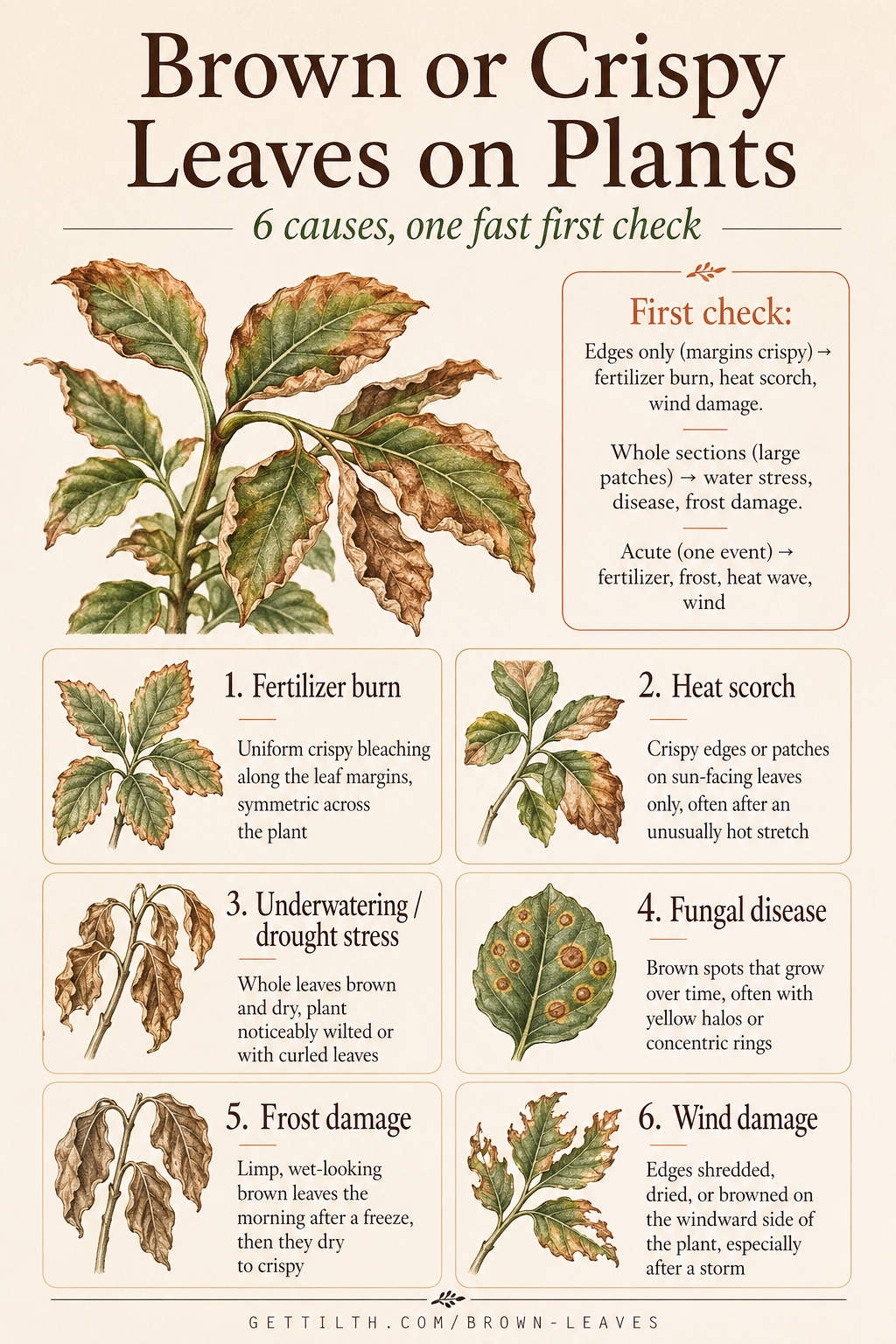
First check: edges or whole sections?
The biggest divide:
- Edges only (margins crispy) → fertilizer burn, heat scorch, wind damage
- Whole sections (large patches) → water stress, disease, frost damage
Then ask: did this happen all at once or has it been spreading?
- Acute (one event) → fertilizer, frost, heat wave, wind
- Spreading over days/weeks → disease, ongoing condition you haven’t fixed
Likely causes
Fertilizer burn
Pattern: Uniform crispy bleaching along the leaf margins, symmetric across the plant. The classic salt-burn signature, very recognizable once you’ve seen it. Often follows a recent fertilizing event.
Confirm: Check what you fertilized with and when. Granular synthetic fertilizers, fresh manure, or over-application of organic blends can all cause this.
Fix: Stop fertilizing. Flush the soil with deep watering (let lots of water drain through) to leach excess salts. Damaged leaves won’t recover but the plant will. Future fertilizing: half-strength, on damp soil, never on dry soil.
Heat scorch
Pattern: Crispy edges or patches on sun-facing leaves only, often after an unusually hot stretch. Lower or shaded leaves look fine.
Confirm: Was there recent heat above 90°F? Did the plant get sudden direct exposure (just transplanted from shade or indoors)?
Fix: Add shade cloth during heat waves. For sudden-exposure damage (post-transplant), the plant will recover as new growth comes in. Harden off plants over a week before moving from shade to full sun.
Underwatering / drought stress
Pattern: Whole leaves brown and dry, plant noticeably wilted or with curled leaves. Soil bone-dry.
Confirm: Stick a finger 2 inches into soil — dry. Plant lifts unusually light (containers).
Fix: Deep water immediately. For containers that have dried completely, soak the whole pot for 20 minutes. Mulch heavily to retain moisture going forward. See watering problems for full prevention.
Fungal disease
Pattern: Brown spots that grow over time, often with yellow halos or concentric rings (early blight). Spots may appear singly or in clusters; eventually whole leaves brown and drop.
Confirm: Look for the characteristic shapes. Bullseye rings = early blight. Small brown spots with yellow halos = septoria. Large irregular dark patches = late blight (serious; can kill tomato or potato plants in days).
Fix: Remove affected leaves immediately. Don’t compost — bag and trash. Improve air circulation; water at soil level only. See diseases for fungal management.
Frost damage
Pattern: Limp, wet-looking brown leaves the morning after a freeze, then they dry to crispy. Most common on tomato, pepper, basil — anything frost-sensitive.
Confirm: Check overnight low for the night before. Was it below 32°F? Did you cover frost-sensitive plants?
Fix: Trim damaged tissue. The plant may recover if the damage is partial; if it was severe, the plant may not. Cover frost-sensitive plants with row cover when the forecast drops below 35°F (cold air collects in low spots even when official forecasts read warmer).
Wind damage
Pattern: Edges shredded, dried, or browned on the windward side of the plant, especially after a storm.
Confirm: Damage is one-sided, matching the prevailing wind direction. More common on container plants, exposed balconies, or unprotected garden positions.
Fix: Move container plants to sheltered positions. Stake or windbreak exposed garden plants. Damaged leaves won’t recover but new growth will.
Plant-specific notes
- Tomato — fertilizer burn from over-application is common; septoria leaf spot causes brown-spotted yellowing from the bottom up.
- Pepper — heat scorch in summer; less prone to most other brown-leaf causes.
- Squash — sudden brown patches often signal squash vine borer or bacterial wilt rather than leaf-specific damage.
- Hydrangea — brown leaf edges in summer almost always = water stress (hydrangeas wilt dramatically when thirsty).
- Rhododendron — brown leaves dropped at the petiole = root rot from waterlogged soil. Different problem from leaf-edge browning.
When to worry vs. when not to
Don’t worry: A few brown leaves at the bottom of an otherwise healthy plant after a hot stretch or windy day. Trim them off.
Do worry: Spreading brown patches, brown spots that increase weekly, or whole sections of the plant going brown. Those are progressing problems that need intervention.
Related
- Environmental stress — heat, frost, wind, drought
- Watering problems — under and over
- Nutrient deficiencies — fertilizer burn lives here
- Diseases — fungal browning patterns
- The diagnosis guide — full diagnostic framework