THE GUIDE
Growing Rhododendrons in the Pacific Northwest
How to grow rhododendrons in the PNW: planting depth (the make-or-break detail), soil acidity, why wet feet kill them, and how to fix the iron deficiency that yellows leaves.
The PNW signature shrub. Rhododendrons evolved in environments that look a lot like ours — cool, damp, acidic, sheltered. They’re mostly forgiving once established, but specific in their requirements: wet feet kill them, alkaline soil yellows them, and planting too deep is the single most common failure. Plant high, mulch well, and they’ll outlive you.
Quick facts
- Plant: transplant fall or early spring, in well-draining acidic soil
- Sun: 4–6 hours filtered light. Morning sun + afternoon shade is ideal.
- Water: 1 inch/week first year; established plants drought-tolerant. Water deeply, infrequently.
- Soil: pH 4.5–6.0 (acidic), well-draining, rich in organic matter
- Mature size: varies widely by cultivar, from 3-foot dwarfs to 15-foot tree-types
When to plant
Best planting windows in PNW:
- Fall (September–November) — roots establish through wet PNW winter
- Early spring (March–April) — before active growth begins
Avoid summer planting unless you can water reliably and shade the plant from direct afternoon sun for the first season.
Planting depth — critical
The single most common reason new rhododendrons die is planting too deep. Their roots are shallow and surface-feeding; buried crowns rot.
Rules:
- Plant the top of the root ball at or slightly above soil level. Never below.
- In heavy clay, mound the planting site 4–6 inches above grade and plant on top of the mound.
- After planting, mulch with 3–4 inches of bark or pine needles, but keep mulch away from the trunk (it traps moisture against the bark and rots it).
- Don’t amend the planting hole heavily — rhododendrons prefer to grow into native soil rather than a “tea cup” of amended soil that holds water differently from surrounding ground.
Cultivars that work
Hundreds of rhododendron cultivars thrive in PNW. Some PNW-specific suggestions:
Compact (3–5 ft):
- PJM — small leaves, lavender flowers, very cold-hardy
- Yaku Princess — pink flowers, dense growth
- Bloombux — newer dwarf with boxwood-like form
Medium (5–8 ft):
- Anna Rose Whitney — large pink trusses, the PNW classic
- Cynthia — large pink-red flowers, tough
- President Roosevelt — variegated leaves, red flowers
- Lem’s Cameo — apricot-pink, exceptional
Large (8+ ft):
- Loderi King George — fragrant white-pink, magnificent
- Pink Pearl — true classic, large pink trusses
For native PNW species: Pacific rhododendron (R. macrophyllum) and western azalea (R. occidentale) — both grow wild here and handle PNW conditions effortlessly.
Visit local rhododendron specialty nurseries (Whitney Gardens, Crystal Springs Rhododendron Garden) for selection guidance.
Sun and soil
PNW rhododendrons want 4–6 hours of filtered or morning light, then afternoon shade. Full afternoon sun causes leaf scorch and lace bug damage. Deep shade reduces flowering.
Soil requirements:
- Acidic, pH 4.5–6.0. Most PNW native soils are close.
- Well-draining. Wet roots = rot. Heavy clay needs amendment or mounding.
- Rich in organic matter. Add compost, pine needles, or aged sawdust.
- Cool root zone. Mulch year-round.
If your soil is alkaline (above 6.0), acidify with elemental sulfur in the year before planting. Pine needle mulch helps maintain acidity over time.
Watering
First year: water deeply once a week if rainfall is light. Don’t let the root ball dry out.
Established plants (year 2+): drought-tolerant in PNW. Water deeply during late-summer dry stretches; otherwise let nature handle it.
Always water at the soil line, not on the leaves or flowers. Avoid frequent shallow watering — encourages surface roots that crash in dry weather.
Common problems
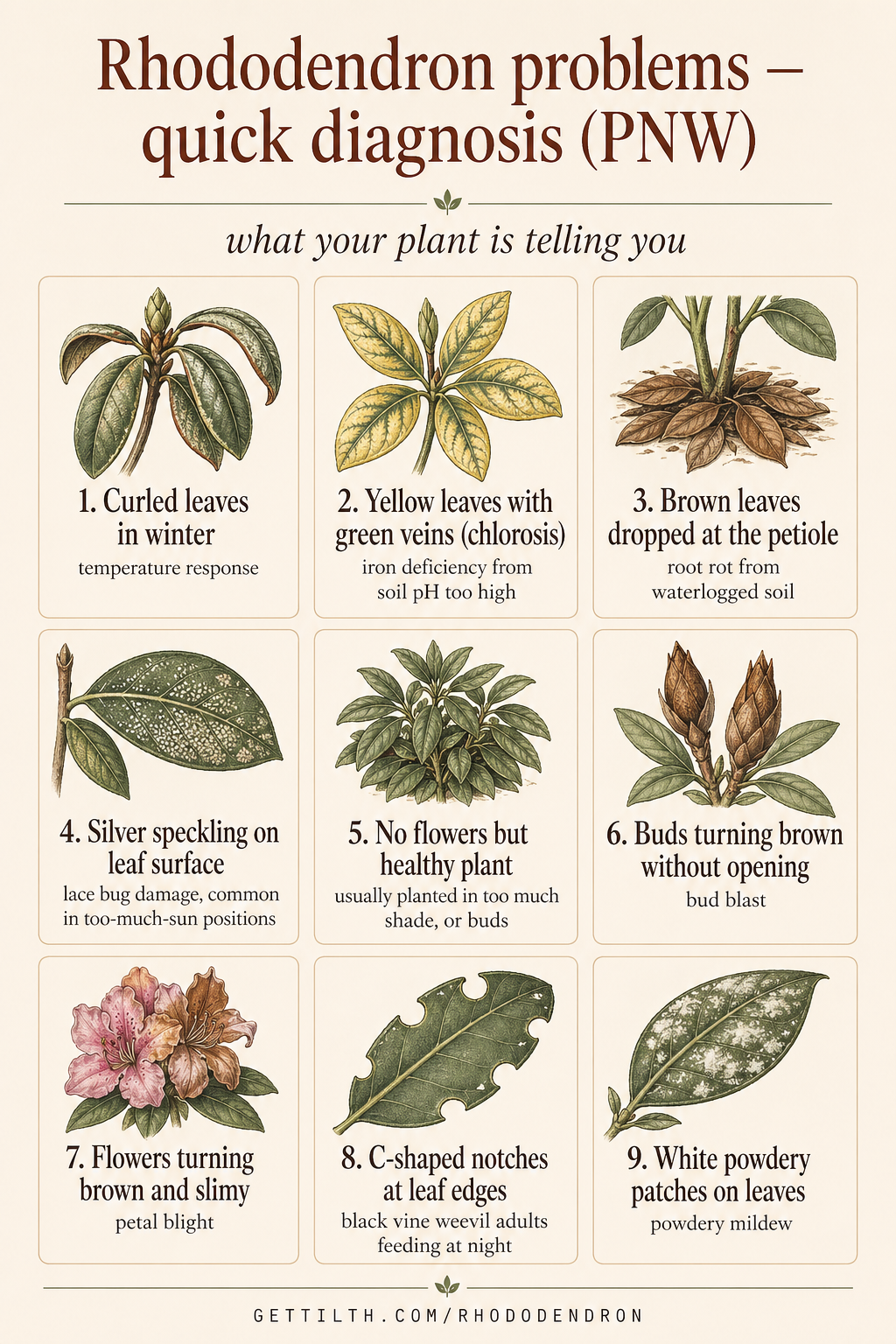
Nine most-asked-about rhododendron problems in PNW gardens:
- Curled leaves in winter — temperature response (thermotropism). Leaves curl tightly when cold to reduce exposed surface area. Normal and harmless; reverses when temperatures rise.
- Yellow leaves with green veins (chlorosis) — iron deficiency from soil pH too high. The most common PNW rhododendron problem and the most fixable. Acidify with sulfur; iron sulfate for short-term relief.
- Brown leaves dropped at the petiole — root rot from waterlogged soil. The most fatal rhododendron problem. Improve drainage, plant higher in heavy clay.
- Silver speckling on leaf surface — lace bug damage, common in too-much-sun positions. Move to more shade or treat with insecticidal soap.
- No flowers but healthy plant — usually planted in too much shade, or buds were killed by late frost.
- Buds turning brown without opening — bud blast (fungal). Common in wet springs. Remove affected buds; improve airflow; copper spray for severe cases.
- Flowers turning brown and slimy in wet weather — petal blight (fungal). Remove affected blooms promptly; doesn’t recur if conditions dry out.
- C-shaped notches at leaf edges — black vine weevil adults feeding at night. Apply beneficial nematodes to soil for larvae control.
- White powdery patches on leaves — powdery mildew. Less common on rhododendrons than other plants but possible in poor airflow positions.
Pruning
Rhododendrons need very little pruning. When you do prune:
- Right after blooming (May–June). Cut back to a leaf rosette; new growth will come from buds at that point.
- Never prune in late summer or fall — you’ll cut off next year’s flower buds.
- For overgrown plants, hard rejuvenation pruning (cutting back to bare wood) works for many cultivars but takes 2–3 years to fully recover.
Deadheading (removing spent flower trusses) is optional but channels energy into next year’s blooms. Pinch off the entire spent truss carefully — don’t damage the new growth buds at the base.
Related plants
- Blueberries — same acidic soil group; share planting requirements
- Azaleas, mountain laurel, kalmia — Ericaceae family relatives
- Hostas, ferns — classic underplanting companions for shaded rhododendron beds
- Pieris, daphne — similar conditions, complementary bloom windows
For underlying patterns affecting rhododendrons (drainage, pH, sun positioning), see the diagnosis guide.